Most first-time home buyer checklists start at "get pre-approved" as if that is step one. It is not. Step one is figuring out whether you can actually afford the house. Your credit score, your debt-to-income ratio, how much cash you need beyond the down payment (spoiler: it is a lot more than you think). Skip the financial prep and you will either lose the house you want to a buyer who moved faster, or get a mortgage that slowly crushes you for 30 years. Both happen constantly.
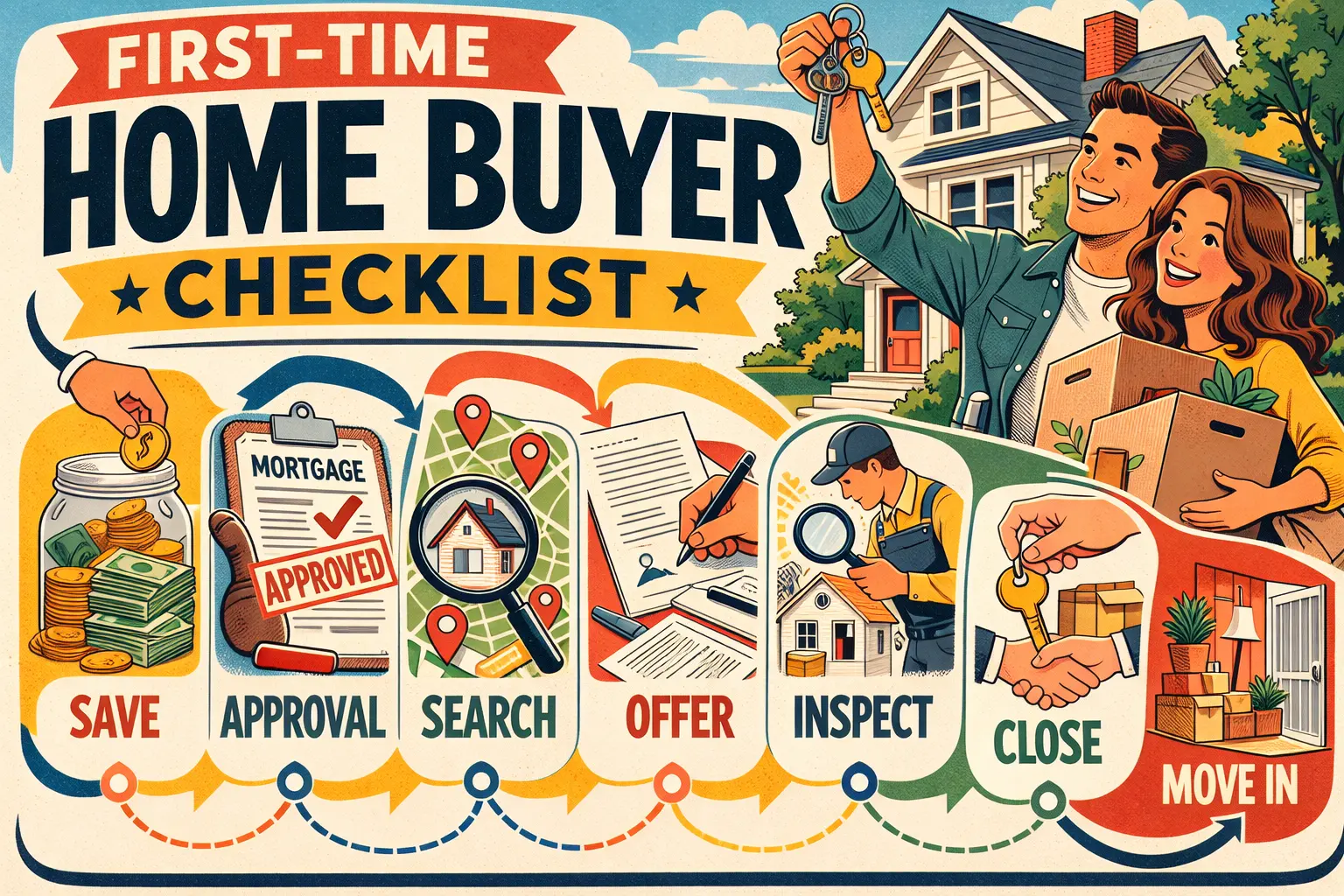
This first time home buyer guide starts where it should: with your money. Real numbers, not "save up for a down payment." Every phase has specific targets, specific documents, and a realistic timeline. If you want a checklist for first time home buyer personalized to your income, savings, and credit score, the First Time Home Buyer Checklist generates one in under a minute. But read through the full version below first so you know what you are looking at.
What the Home Buying Process Actually Looks Like
Here is the timeline nobody tells you. The fun part, looking at houses, touring kitchens, imagining your life in that sunlit living room, takes about 2 to 3 months. The boring part, getting your finances in shape and shopping for a mortgage, takes 3 to 12 months. Most first time buyers rush through the boring part or skip it entirely. Then they wonder why they got outbid, or why their monthly payment feels like it is eating them alive.
| Phase | What Happens | Timeline |
|---|---|---|
| 1. Financial Readiness | Credit repair, savings, debt payoff | 3-12 months before |
| 2. Mortgage Pre-Approval | Loan shopping, rate comparison, documentation | 2-3 months before |
| 3. House Hunting | Search, tours, neighborhood research | 1-3 months |
| 4. Offer and Negotiation | Submit offer, negotiate terms, earnest money | 1-2 weeks |
| 5. Home Inspection | Property evaluation, repair negotiations | 1-2 weeks |
| 6. Closing | Final walkthrough, paperwork, key handoff | 30-45 days after accepted offer |
| 7. After Closing | Utilities, address changes, maintenance plan | First 30 days |
Most online buying a house checklist resources cover phases 3 through 6. The steps below cover all seven.
Phase 1: Financial Readiness (3 to 12 Months Before)
Your financial readiness determines your buying power, your interest rate, and whether you'll qualify for first time home buyer programs. Start here, not at the open house.
Credit Score
Check your score through annualcreditcheck.com (free, no impact on score). Here are the thresholds that matter:
| Credit Score | What It Means for You |
|---|---|
| 760+ | Best rates. Conventional loans with the lowest PMI |
| 700-759 | Good rates. Conventional loans available, slightly higher PMI |
| 620-699 | Conventional loans possible but rates jump. Consider FHA |
| 580-619 | FHA loans require 3.5% down. Conventional unlikely |
| Below 580 | FHA requires 10% down. Most lenders won't approve conventional |
If your score is below 700, spend 3 to 6 months improving it before shopping for mortgages. Paying down credit card balances below 30% utilization is the fastest improvement lever. One late payment can drop your score 50 to 100 points and take months to recover.
Savings Target
The down payment is not your only cash need. Here's what you actually need saved for a $350,000 home:
| Cost | Amount | Notes |
|---|---|---|
| Down payment (3% conventional) | $10,500 | First time buyers often qualify for 3% down |
| Down payment (3.5% FHA) | $12,250 | FHA minimum with 580+ credit |
| Down payment (20% conventional) | $70,000 | Avoids PMI entirely |
| Closing costs (2-5% of price) | $7,000 to $17,500 | Lender fees, title insurance, appraisal, taxes |
| Moving costs | $1,500 to $5,000 | Depends on distance and whether you hire movers |
| Emergency fund (3 months PITI) | $6,000 to $9,000 | Mortgage + insurance + taxes + HOA |
| Earnest money deposit | $3,500 to $7,000 | Typically 1-2% of purchase price |
Total cash needed (3% down): $28,500 to $49,000 for a $350,000 home. That number surprises most first time buyers who only planned for the down payment.
Debt-to-Income Ratio
Lenders want your total monthly debt payments (including the new mortgage) below 43% of gross monthly income. Many prefer below 36%.
Calculate yours: add all monthly debt payments (student loans, car payment, credit cards, personal loans) plus your estimated mortgage payment. Divide by your gross monthly income.
Example: $80,000 salary = $6,667/month gross. At 36% DTI, your total monthly debt plus mortgage can't exceed $2,400. If you already pay $500/month in student loans and $350 in car payment, your maximum mortgage payment is $1,550.
First Time Home Buyer Programs
First time home buyer programs can save you $10,000 to $50,000 in down payment and closing costs. Most buyers don't check because they assume they won't qualify.
Programs to research:
- FHA loans: 3.5% down with 580+ credit. Government-backed.
- VA loans: Zero down payment for veterans and active military. No PMI.
- USDA loans: Zero down for rural and some suburban areas. Income limits apply.
- State HFAs: Most states offer down payment assistance grants or low-interest second mortgages for first time buyers. Check your state's Housing Finance Authority.
- Employer programs: Some employers offer down payment matching or housing stipends.
"First time buyer" has a broader definition than you'd think. In most programs, it means anyone who hasn't owned a home in the past three years. If you owned a home five years ago and sold it, you likely qualify.
Phase 2: Mortgage Pre-Approval (2 to 3 Months Before)
Pre-approval tells you exactly how much house you can afford, and it tells sellers you're a serious buyer. Pre-qualification is a quick estimate. Pre-approval involves a credit check, income verification, and a conditional commitment from the lender.
Documents You'll Need
Gather these before your first lender meeting:
- Two years of W-2s or 1099s
- Two years of federal tax returns
- Two months of pay stubs
- Two months of bank statements (all accounts)
- List of all debts with balances and monthly payments
- Photo ID and Social Security number
- Employment history (past two years)
- Gift letters if using gifted funds for down payment
Self-employed buyers need two years of business tax returns and a year-to-date profit and loss statement.
Rate Shopping
Get quotes from at least three lenders. Mortgage rates vary by 0.5% or more between lenders on the same day for the same borrower. On a $300,000 30-year mortgage, a 0.5% rate difference costs you about $30,000 over the life of the loan.
All credit inquiries for mortgages within a 45-day window count as a single inquiry on your credit report. Shop aggressively during that window.
Compare: interest rate, APR (includes fees), closing cost estimate, lender fees, points, and lock period.
Phase 3: House Hunting
Know your non-negotiables before you start looking, not after you fall in love with a house you can't afford. This is one of the most important things to know when buying a house, and it's where emotional decisions start overriding financial ones.
Must-Haves vs. Nice-to-Haves
Split your requirements into three categories:
| Category | Examples | Rule |
|---|---|---|
| Non-negotiable | Bedroom count, school district, commute under 30 min, garage | Won't tour homes missing these |
| Strong preference | Updated kitchen, yard size, specific neighborhood | Would pay up to 5% more for these |
| Nice-to-have | Pool, finished basement, walk-in closet | Won't affect your offer price |
What to Look for When Buying a House
Beyond the cosmetics, here is what to look for when buying a house that will hold its value:
Structure and systems. Foundation cracks, roof age (replacement costs $8,000 to $25,000), HVAC age (replacement costs $5,000 to $12,000), water heater age, electrical panel capacity (100 amp minimum for modern homes, 200 amp preferred).
Location factors. Flood zone status (check FEMA maps, affects insurance cost), proximity to highways or train tracks (noise and air quality), cell service quality, internet availability (check ISP coverage maps before making an offer).
Neighborhood data. School ratings even if you don't have kids (affects resale value), crime statistics, property tax trends (some areas increase 5 to 10% annually), HOA restrictions and fee history.
Red flags during tours. Fresh paint over textured walls (potential moisture cover-up), musty smell in basement, water stains on ceilings, uneven floors, doors that won't close properly, exterior grading that slopes toward the foundation.
The First Time Home Buyer Checklist generates a personalized checklist based on your income, savings, credit score, property type, and must-have features. It covers all six phases from financial readiness through closing day.
Phase 4: Making an Offer
Your offer is more than a price. It's a package of terms that can make or break the deal. In competitive markets, the strongest offer isn't always the highest dollar amount.
Offer Components
| Component | What to Include | First Timer Tip |
|---|---|---|
| Purchase price | Based on comps, not asking price | Ask your agent for 3 recent comparable sales within 0.5 miles |
| Earnest money | 1-2% of purchase price | Higher earnest money signals seriousness to the seller |
| Contingencies | Inspection, appraisal, financing | Waiving contingencies is risky for first time buyers. Keep all three. |
| Closing date | 30-45 days is standard | Flexibility on closing date can win over a seller more than extra dollars |
| Inclusions | Appliances, fixtures, window treatments | Get anything you expect to stay in writing |
| Escalation clause | Auto-increase up to a cap | Useful in multiple-offer situations but reveals your ceiling |
Contingencies to Keep
Never waive these as a first time home buyer:
Inspection contingency. Allows you to negotiate repairs or walk away if major issues surface. Waiving this is one of the most common (and expensive) first time home buyer mistakes.
Appraisal contingency. Protects you if the home appraises below your offer price. Without it, you're on the hook for the gap in cash.
Financing contingency. If your loan falls through for any reason, this lets you exit without losing your earnest money deposit.
Phase 5: Home Inspection
The home inspection is your last chance to discover problems before they become your problems. Budget $300 to $600 for a general inspection. Specialty inspections (radon, termite, sewer scope, mold) run $100 to $300 each.
Your First Time Home Buyer Inspection Checklist
A general home inspection covers:
- Roof: Age, condition, missing or damaged shingles, flashing around chimneys and vents
- Foundation: Cracks, settling, water intrusion, drainage
- Electrical: Panel capacity, wiring type (copper vs. aluminum), GFCI outlets in wet areas
- Plumbing: Pipe material, water pressure, water heater age and condition, sewer line
- HVAC: Age, maintenance history, ductwork condition
- Insulation: Attic insulation depth, wall insulation, vapor barriers
- Exterior: Siding condition, grading, gutters, deck and patio structural integrity
- Interior: Windows (single vs. double pane), doors, flooring, walls, ceilings
Biggest red flags: Foundation issues (repair costs $5,000 to $30,000+), active termite damage, knob-and-tube wiring, polybutylene plumbing, mold in attic or crawl space, roof with less than 3 years remaining.
The Home Inspection Checklist generates a property-specific home inspection checklist based on the home's age, type, climate zone, and your budget sensitivity. It catches issues that generic inspection lists miss because it's tailored to your exact situation.
After the Inspection
Three options based on findings:
- Request repairs. Seller fixes specific issues before closing. Get contractor estimates to back your requests.
- Request credits. Seller reduces the price or provides closing cost credits. You handle repairs after closing on your own terms.
- Walk away. If major structural, environmental, or safety issues surface, use your inspection contingency to exit.
Minor cosmetic issues (scratched floors, outdated fixtures, paint) aren't negotiation items. Focus on structural, safety, and major system concerns.
Phase 6: Closing
The home closing checklist for buyer involves more paperwork than the rest of the process combined. Your closing date is typically 30 to 45 days after the accepted offer. Here are the steps to buying a house in the final stretch.
Your First Time Home Buyer Checklist Before Closing
Two weeks before closing:
- Confirm homeowner's insurance policy is bound (lender requires proof)
- Schedule final walkthrough (do this 24 to 48 hours before closing, not earlier)
- Review Closing Disclosure (lender sends this 3 business days before closing, by law)
- Compare Closing Disclosure to your Loan Estimate. Flag any fees that increased more than 10%.
Day of closing:
- Bring government-issued photo ID
- Bring cashier's check or wire transfer confirmation for closing costs (personal checks usually not accepted)
- Review every page before signing. Ask questions about anything unclear.
- Verify the correct names and property address on all documents
- Get copies of everything you sign
What you're signing: Promissory note (your promise to repay), mortgage or deed of trust (the lien on the property), closing disclosure (final costs), title documents, tax and insurance escrow agreements.
The Home Closing Checklist generates a personalized closing timeline based on your role, property type, transaction type, and any contingencies still outstanding.
Closing Costs Breakdown
Expect to pay 2% to 5% of the purchase price. Here's where it goes:
| Fee | Typical Range | Who Pays |
|---|---|---|
| Origination fee | 0.5-1% of loan | Buyer |
| Appraisal | $300 to $600 | Buyer |
| Title insurance (lender's) | $500 to $1,500 | Buyer |
| Title insurance (owner's) | $500 to $2,000 | Varies by state |
| Recording fees | $50 to $250 | Buyer |
| Prepaid property taxes | 2-6 months | Buyer |
| Prepaid homeowner's insurance | 12 months | Buyer |
| Escrow deposit | 2-3 months taxes + insurance | Buyer |
| Attorney fees | $500 to $1,500 | Varies by state |
The Home Appraisal Checklist helps you prepare the property for appraisal if the lender-ordered appraisal comes in low. A low appraisal can delay or kill the deal.
Phase 7: After Closing
The checklist after buying a house is just as important as the one before. The first 30 days set the foundation for maintaining your investment.
First Time Home Buyer Checklist After Closing
Immediately:
- Change all locks (you don't know who has copies of the old keys)
- Transfer utilities into your name (electric, gas, water, internet, trash)
- Update your address with USPS, DMV, banks, insurance, employer, and subscriptions
- File your homestead exemption (if your state offers property tax reductions for primary residences)
- Set up autopay for your mortgage
First week:
- Locate and label your main water shutoff, electrical panel, and gas shutoff
- Test all smoke detectors and carbon monoxide detectors. Replace batteries.
- Document the condition of every room with photos and video (timestamps matter for insurance claims)
- Review your HOA rules and meeting schedule (if applicable)
First month:
- Create a home maintenance calendar (HVAC filter changes quarterly, gutter cleaning twice yearly, water heater flush annually)
- Get quotes for any deferred maintenance items from your inspection
- Start building a home repair emergency fund (budget $1 to $3 per square foot annually)
- Check for first time home buyer tax deductions (mortgage interest, property taxes, points paid at closing)
First Time Home Buyer Move In Checklist
Your first time home buyer moving checklist should start 4 to 6 weeks before your move date:
- 6 weeks out: Get quotes from three moving companies or reserve a truck
- 4 weeks out: Start packing non-essentials, notify subscriptions of address change
- 2 weeks out: Confirm movers, pack room by room, label boxes by room and priority
- Moving day: Do a final walkthrough of your old place, read all utility meters, keep valuables and important documents with you (not on the truck)
- First night: Have an essentials box ready (toilet paper, soap, towels, phone charger, basic tools, sheets, medications, snacks)
Common First Time Home Buyer Mistakes
Every one of these costs people real money. Not hypothetical money. Actual dollars they watched disappear because nobody warned them.
1. House hunting without pre-approval. You tour 15 homes. You fall in love with number 12. You submit an offer. Another buyer, already pre-approved, submits the same offer. The seller picks them because they can close in 30 days and you need 60. You just wasted a month. Get pre-approved before you open Zillow.
2. Putting every dollar into the down payment. You scrape together exactly 3% down and close with $47 in your savings account. Two weeks later the water heater dies. That is $1,500 you do not have. Keep 3 months of mortgage payments in reserve. Always.
3. Buying a couch before closing. The timeline between pre-approval and closing feels like "you basically own the house." You do not. That Restoration Hardware order you financed? That new car lease? Lenders pull your credit again before closing. Your DTI ratio just changed and now your loan is denied. Do not touch your credit until you have the keys in your hand.
4. Waiving the inspection to "win" the offer. In competitive markets, every real estate forum is full of first time home buyer tips like "waive inspection to stand out." A $500 inspection protects you from $30,000 foundation problems. Waiving it is not competitive strategy. It is gambling with money you do not have yet.
5. Only looking at the mortgage payment. Your lender says $1,800/month. Manageable. But then you add property taxes ($350), homeowner's insurance ($150), PMI ($120), HOA ($200), maintenance reserves ($200), and utilities ($250). That $1,800 mortgage is actually a $3,070 monthly housing cost. Run the full number before you fall in love with a listing.
Building Your Home Buyer Checklist with AI
The checklist above covers the process for everyone. But your actual situation has specific numbers: your income, your credit score, your savings, the market you are buying in. Generic checklists cannot account for any of that.
The First Time Home Buyer Checklist generates a home buying checklist built around your numbers. Plug in your income, savings, credit score, target price range, and must-haves. It runs the DTI math, flags programs you qualify for, and sequences the steps by your specific timeline. Works in ChatGPT, Claude, Gemini, or the Dock Editor.
You will also want these at specific phases:
- Home Inspection Checklist before your inspection appointment (Phase 5)
- Home Closing Checklist when your closing date is set (Phase 6)
- Home Appraisal Checklist if the appraisal comes in low
All free. Open any of them in the Dock Editor to generate and edit in one place.
FAQ
How much money do I need to buy a house for the first time?
Plan for 3% to 20% down payment plus 2% to 5% in closing costs plus 3 months of mortgage payments in reserves plus moving costs. For a $350,000 home with 3% down, you need roughly $28,500 to $49,000 in total cash. First time home buyer programs and down payment assistance can reduce the upfront amount significantly.
What credit score do I need to buy a house?
A 620 credit score qualifies for conventional loans. FHA loans require 580 for 3.5% down or 500 for 10% down. However, anything below 700 means higher interest rates and more expensive mortgage insurance. Spending 3 to 6 months improving your score before applying can save tens of thousands over the life of the loan.
How long does it take to buy a house from start to finish?
The full home buying process takes 3 to 12 months. Financial preparation takes 3 to 12 months depending on your starting position. Once you start house hunting, expect 1 to 3 months to find the right home and another 30 to 45 days from accepted offer to closing.
What is the 30/30/3 rule for buying a house?
The 30/30/3 rule is an affordability guideline: spend no more than 30% of gross income on housing, have at least 30% of the home's value in cash (down payment plus reserves plus closing costs), and the price should be no more than 3 times your annual income. It's more conservative than what lenders will approve, which is the point.
What are the biggest red flags in a home inspection?
Foundation cracks with active movement, active water intrusion, knob-and-tube wiring, polybutylene plumbing, active termite damage, mold in the attic or crawl space, and a roof with less than 3 years of life remaining. Any of these can cost $5,000 to $30,000+ to fix. Walk away or negotiate a significant price reduction.