Your Front Door Just Changed: The AI Agents Are Already Knocking
For 25 years, every platform on the internet was designed to keep bots out.
CAPTCHAs. Rate limits. WAFs. Cloudflare challenges. Device fingerprinting. If your request looked automated, the door slammed shut.
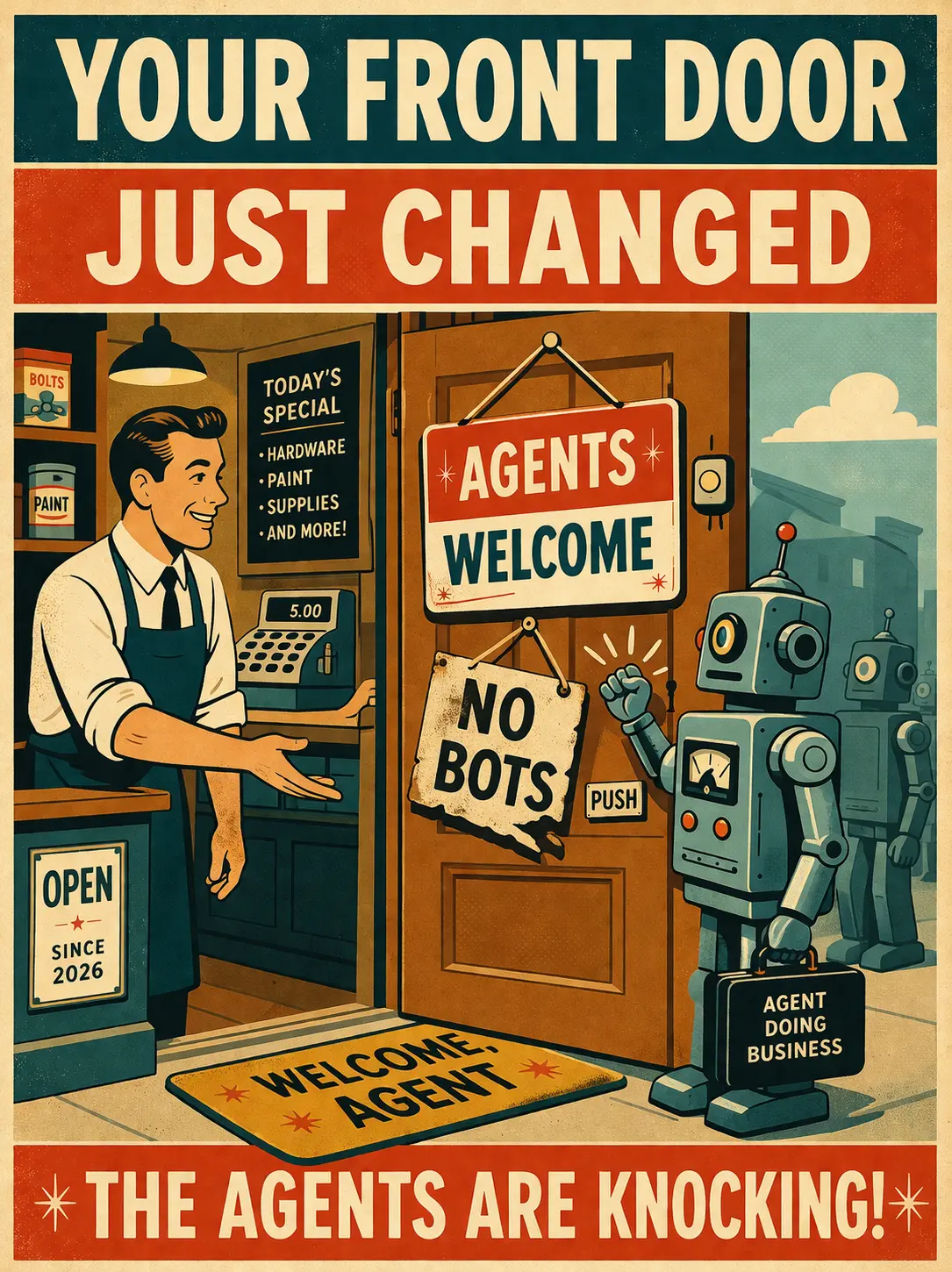
Then, in the span of about 18 months, the biggest platforms on earth quietly flipped the sign from "No Bots" to "Bring Your Own Agent."
Let me walk through the receipts.
The commerce layer said yes first
In late 2025, OpenAI and Stripe shipped the Agentic Commerce Protocol — an open standard that lets ChatGPT complete a purchase inside the conversation. No redirect. No "click here to open Shopify." The agent buys.
Six months later, over a million Shopify merchants are live inside ChatGPT. Glossier, SKIMS, Spanx, Vuori — all agent-buyable. Shopify then co-authored the Universal Commerce Protocol with Google so agents could transact through Google Search and Gemini too. Stripe shipped the Agentic Commerce Suite with a single pitch: "get your business agent-ready."
Microsoft Copilot Checkout launched in January with Shopify, PayPal, and Etsy. Microsoft's own numbers: 53% more purchases within 30 minutes when agentic shopping intent is present.
Let that number breathe. A 53% lift in conversion — not because the marketing copy got better, but because the agent didn't have to fight the interface.
The protocol layer said yes next
If a platform wants to be operable by an agent, the agent needs a map. That map is the Model Context Protocol — the thing Anthropic shipped in November 2024 that nobody outside the AI-nerd Discords cared about for six months.
Eighteen months later: 10,000+ active MCP servers. 97 million monthly SDK downloads. Adopted by OpenAI, Google DeepMind, Microsoft, Cloudflare, Block, and AWS. In December 2025, Anthropic donated MCP to the newly formed Agentic AI Foundation under the Linux Foundation — co-founded with Block and OpenAI.
Translation: the protocol for letting an agent operate your system is no longer a thing. It's the thing. Every major AI provider is on the same standard. The "no bots" internet is being rebuilt with the welcome mat pre-installed.
The workplace is saying yes last — but it's saying yes
The next shift is already moving, even if it's not on every investor slide yet.
BYOA — Bring Your Own Agent. The pattern where an employee doesn't show up with just their laptop. They show up with their pre-trained agent stack. The designer brings their Claude, their Cursor, their Figma-agent, their triage bot. HR's job isn't to provision them — it's to let them through the door. Matt Warren called it "the new workplace shift nobody's naming yet."
Gartner projects 40% of business apps will ship with AI agents by the end of 2026. The global AI-agent market: $28B today, projected $147B by 2030.
That's not a content-farm number. That's a procurement line item.
What the smart money is actually saying
Andrew Chen at a16z — who literally wrote the book on growth and distribution — has been clear: as AI makes shipping software trivially cheap, brand, distribution, and community become the moats. Not code. Not features. The distribution channel IS the killer app. And in 2026, the emerging distribution channel is the agent.
Bret Taylor at Sierra — ex-co-CEO of Salesforce, chair of OpenAI's board — said it sharper: "The era of clicking buttons is over."
If your SaaS product requires a human to click 7 times to complete a task, that human is being replaced by an agent who wants to do it in one API call. You're either the platform that exposes that API, or you're the one being disintermediated by the one that does.
Taylor isn't posturing. Sierra is deploying customer agents in four weeks for Nordstrom. $100M ARR in under two years. $10B valuation. They're not selling software. They're selling the welcome mat.
The three questions every business should answer by Friday
If you run a business in April 2026, you need an answer — a real one, not a roadmap bullet — to each of these:
- Can an agent buy from you? Not eventually. This week. Is there a payment + catalog path that doesn't require a human clicking through your checkout funnel?
- Can an agent read your business context? Your hours, your menu, your price list, your availability. Is it in an MCP server, in an agent-readable schema — or still buried inside a React SPA that a scraper has to fight?
- Can an agent call you — voice, chat, email — and have the call end in a booking, a refund, or a quote without a human in the loop? Because your competitor's agent is already trying to reach yours.
If the answer to any of these is "no," the next two years are going to feel like watching mobile-first eat desktop-only — from the wrong side.
What we're building (for full transparency)
We're building AgentDock. It's the AI employee that sits on both sides of this door.
On the welcome side: when an agent calls your business at 2am to book a repair for their user, our agent answers the phone, captures the context, books the job, and updates your CRM. No human intermediary. No missed call, and 62% of small-business calls currently go unanswered.
On the knocking side: Dock is the Chrome extension and prompt library that lets your agents carry context across Gmail, ChatGPT, Claude, LinkedIn, and whatever ships next month. BYOA, for the individual operator.
Both sides of the same bet: the businesses that welcome agents will win the decade.
The last thing I'll say
I spent a decade building distribution — as the first engineer at Udemy, then at Coinbase. I watched mobile-first eat desktop-only. I watched API-first eat manual-integration-only. I watched cloud-first eat on-prem-only. The pattern is the same every time.
The companies that designed for the new interface won. The ones that bolted it on lost. The ones that actively blocked it, "no, we prefer customers come through our website" disappeared.
Agents are the new interface. The welcome mat is already on the floor at Shopify, Stripe, OpenAI, Google, Microsoft, Anthropic. The question isn't whether you should roll one out.
It's whether you'll do it before your competitor's agent knocks on their door instead.