Most business continuity plans fail because they sit in a binder nobody opens. The template is the easy part. Seven sections, some tables, a contact list. Every government agency and SaaS company on the internet will give you that structure for free. The part where companies get stuck is filling in the sections with specifics that someone can actually follow when the power goes out, the servers go down, or a vendor disappears.
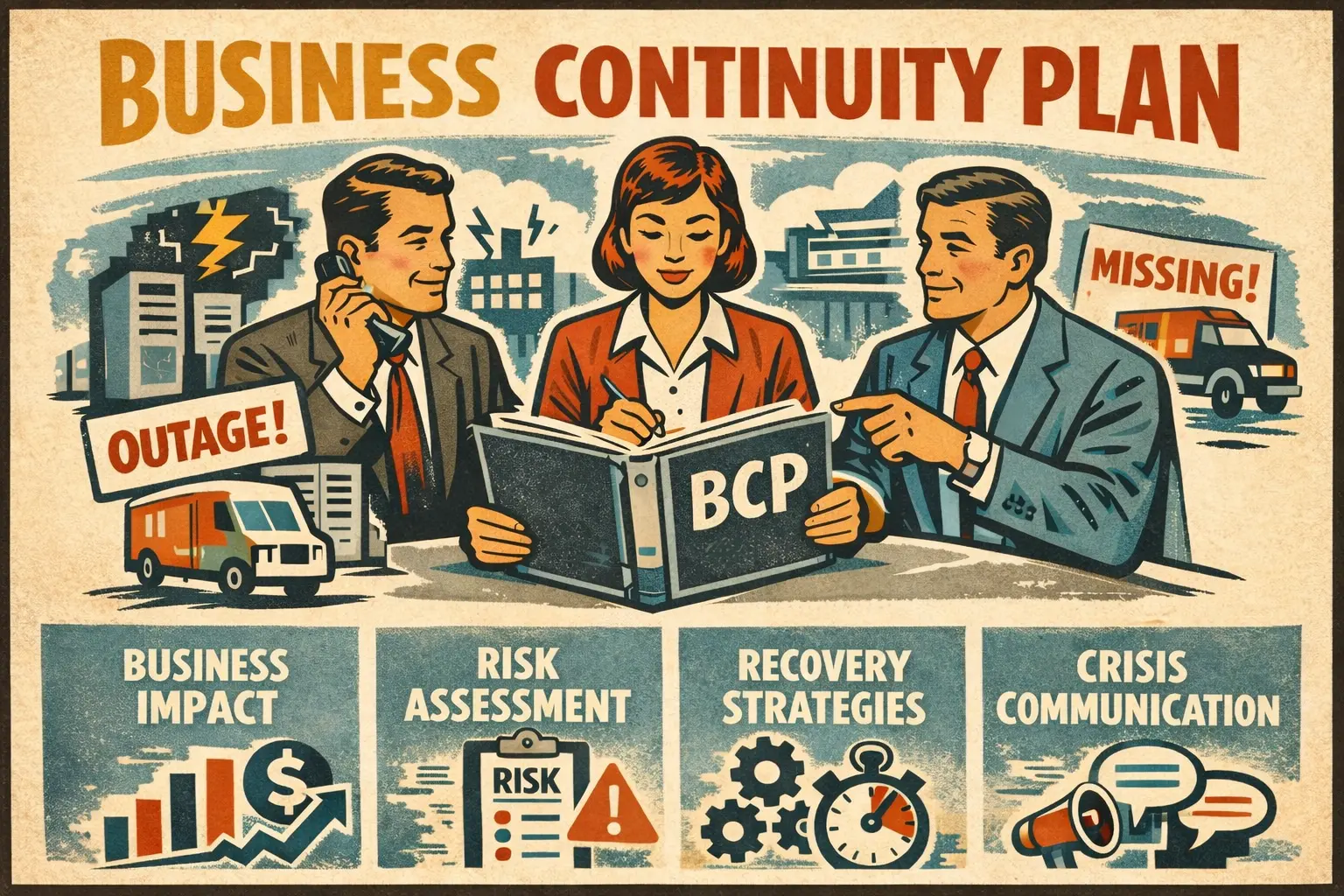
A generic BCP template produces a generic plan. A generic plan gives your team nothing actionable during a real disruption and gives your auditor nothing to validate. The difference between a business continuity plan that works and one that collects dust is about four hours of focused work on the business impact analysis and recovery strategies.
Here is how to build one that people can actually execute. Every template linked below is free and works in ChatGPT, Claude, Gemini, or any AI tool you already use.
What a Business Continuity Plan Actually Includes
A business continuity plan is a documented process that identifies critical business functions, assesses the threats to those functions, and defines the recovery procedures to keep operating when something goes wrong. Not a disaster recovery plan (that is IT-specific). Not a crisis communication plan (that is one section of a BCP). A complete operational resilience framework.
Every business continuity plan template needs seven components. Skip one and you are building a document that looks good on a shelf but fails under pressure.
Business impact analysis (BIA). The foundation of the entire plan. Identifies which functions matter most by quantifying the financial and operational cost of downtime. Without a BIA, you are guessing at priorities. More on this below because it is where most plans stall.
Risk assessment. Threat identification with likelihood and impact scoring. What could go wrong, how likely is it, and how bad would it be. The Risk Assessment Generator creates a scored risk register with R001-R999 format, 5-point likelihood/impact matrix, and mitigation strategies for each risk.
Recovery strategies. Step-by-step procedures for restoring each critical function. Who does what, in what order, with what resources. This section must include a recovery time objective and recovery point objective for each function.
Crisis communication plan. Who gets notified, by whom, through what channel, within what timeframe. The Communication Plan Template generates a stakeholder communication matrix with channels, timing, and template messages for each audience.
Supply chain continuity. Backup vendors, minimum inventory thresholds, and contractual provisions for critical dependencies. Companies that lost months of revenue during COVID learned this section matters.
Testing and exercise schedule. Tabletop exercises, functional drills, and full-scale simulations on a twelve-month calendar. A plan that has never been tested is a theory, not a plan.
Plan maintenance. Review cycles, update triggers, version control, and training schedules. Plans go stale faster than you think. ISO 22301 requires at least annual reviews.
If your business continuity plan template is missing any of these, you are building a document that creates a false sense of security.
Which Sections to Prioritize by Company Size
Not every organization needs the same level of detail in every section. A 20-person company building the same 80-page BCP as a Fortune 500 firm is wasting time on sections that do not apply and skipping the ones that do.
| Company Size | Critical Sections | Can Simplify | Why |
|---|---|---|---|
| Small Business (1-50) | BIA, Recovery Strategies, Crisis Communication | Supply Chain (if no physical products), Governance | Few dependencies, small team can improvise. Focus on the functions that generate revenue |
| Mid-Market (51-500) | BIA, Risk Assessment, Recovery Strategies, Communication | Testing (quarterly vs monthly) | More complexity, but still manageable. Key risk: single points of failure in people |
| Enterprise (500+) | All seven sections at full depth | Nothing. Every section matters at this scale | Regulatory requirements (SOC 2, HIPAA, ISO 22301), multiple locations, complex supply chains |
Best for: Any company that has experienced a disruption and realized their response was improvised. Also required for SOC 2 Type II, ISO 22301 certification, HIPAA compliance, and financial services regulation.
Skip if: You are a solo consultant or freelancer with no employees, no physical inventory, and no contractual SLA obligations. Your "BCP" is a backup laptop and a second internet connection.
A business continuity plan for small business does not need to be 60 pages. It needs to cover the three things that would shut you down: your revenue-generating functions, how to keep them running, and who to call. The Business Continuity Plan Template scales to five company sizes and thirteen industries, so it generates the right level of detail for your situation.
How to Write a Business Impact Analysis That Actually Works
The business impact analysis is where most business continuity planning efforts stall. People get overwhelmed by the scope and either skip it or fill it with vague statements like "significant financial impact" that help nobody.
A BIA answers one question: if this function stops, how much does it cost per hour and per day? That number determines everything else. Recovery priorities, budget allocation, staffing decisions.
Step-by-Step BIA Process
1. List every business function. Not departments. Functions. "Process customer orders" is a function. "Sales department" is an org chart label. Start with revenue-generating functions, then move to supporting functions.
2. Identify the owner. Every function needs one person accountable for its recovery. Not a team. One name and phone number.
3. Quantify the cost of downtime. This is the hard part. Break it into three categories:
- Revenue loss. Direct revenue that stops flowing. If your e-commerce site goes down and you do $50,000/day in sales, that is $2,083/hour.
- Operational cost. Extra expenses from the disruption. Overtime labor, emergency vendor contracts, expedited shipping. These add up faster than the revenue loss.
- Regulatory or contractual penalties. SLA violations, regulatory fines, contractual liquidated damages. Check your contracts. A healthcare company missing HIPAA breach notification deadlines faces $100-$50,000 per violation.
4. Determine the recovery time objective (RTO). The maximum acceptable downtime before serious harm occurs. This is not aspirational. It is the point where the cost of downtime exceeds the cost of recovery infrastructure. A payment processing function might have a 1-hour RTO. A marketing newsletter might have a 7-day RTO.
5. Determine the recovery point objective (RPO). The maximum acceptable data loss measured in time. If your RPO is 4 hours, you need backups running at least every 4 hours. If it is zero, you need real-time replication.
6. Map dependencies. Which systems, vendors, and teams does each function depend on? If "process customer orders" depends on your ERP, your payment gateway, and your warehouse management system, all three need recovery strategies.
BIA Example: Completed Table
Here is a business continuity plan example of a completed BIA for a mid-market e-commerce company. This is the kind of specificity that makes a sample business continuity plan actually useful.
| Function | Owner | Revenue Impact/Day | RTO | RPO | Key Dependencies |
|---|---|---|---|---|---|
| Order Processing | VP Operations | $52,000 | 4 hours | 1 hour | ERP, payment gateway, warehouse mgmt |
| Customer Support | Support Director | $8,000 (refund costs) | 8 hours | 4 hours | Helpdesk platform, CRM, phone system |
| Website/Storefront | CTO | $52,000 | 1 hour | 15 minutes | CDN, database, hosting provider |
| Warehouse Fulfillment | Logistics Manager | $35,000 | 24 hours | 4 hours | WMS, shipping carriers, inventory system |
| Payroll Processing | CFO | $0 (but legal risk) | 72 hours | 24 hours | HRIS, banking integration, tax service |
| Marketing Campaigns | Marketing Director | $3,000 (opportunity cost) | 7 days | 24 hours | Email platform, analytics, ad accounts |
Notice the pattern. The functions with the highest revenue impact per day get the shortest RTOs. Marketing has a 7-day RTO because a week without campaigns is inconvenient, not catastrophic. Website downtime at $52,000/day gets a 1-hour RTO because every hour of delay is measurable money. That ranking is the entire point of a business impact analysis template. It tells you where to spend your recovery budget.
The Business Continuity Plan Template generates a complete BIA table from the critical functions and disruption scenarios you describe. Select your company size, industry, and recovery time objectives, and the output includes financial impact estimates calibrated to your sector.
Building Your Risk Assessment
After the BIA tells you what matters, the risk assessment tells you what could go wrong. The two work together. Without the BIA, your risk assessment has no priorities. Without the risk assessment, your recovery strategies have no focus.
Use a 5-point likelihood and impact matrix. Likelihood from 1 (rare, less than 5% chance in any given year) to 5 (almost certain, greater than 80% chance). Impact from 1 (negligible, less than $10,000) to 5 (catastrophic, threatens business survival). Multiply for a risk score of 1-25.
| Risk Score | Level | Action Required |
|---|---|---|
| 1-4 | Low | Monitor. Review quarterly. |
| 5-9 | Medium | Mitigate. Assign owner, implement controls within 90 days. |
| 10-15 | High | Priority. Dedicated budget, monthly review, active mitigation. |
| 16-25 | Critical | Immediate. Executive attention, weekly review, full mitigation plan. |
Risk Assessment Example
For the same e-commerce company, here are the top five risks from a Risk Assessment Generator output:
| Risk ID | Threat | Likelihood | Impact | Score | Level |
|---|---|---|---|---|---|
| R001 | Ransomware encrypts order database | 4 | 5 | 20 | Critical |
| R002 | Primary cloud provider outage (>4 hrs) | 3 | 5 | 15 | High |
| R003 | Key vendor (payment gateway) failure | 3 | 4 | 12 | High |
| R004 | Warehouse flood/fire | 2 | 5 | 10 | High |
| R005 | Mass employee illness/pandemic | 2 | 4 | 8 | Medium |
Each risk needs two responses: a preventive action (reduce likelihood) and a contingency action (minimize impact if it happens). R001 gets daily offsite backups, endpoint detection, and a tested restore procedure. R003 gets a secondary payment processor configured and ready to activate. The Risk Assessment Generator produces the full risk register with preventive actions, contingency plans, monitoring triggers, and suggested owners for each risk.
Writing Recovery Strategies That Work Under Pressure
Recovery strategies are where business continuity planning goes from analysis to action. This is the section your team will actually read at 2 AM when the servers are down and the CEO is calling.
Three rules for recovery procedures that people can follow:
1. Number every step. "Restore the database" is not a procedure. "Step 1: SSH into backup server at 10.0.1.50. Step 2: Run /opt/scripts/restore-latest.sh. Step 3: Verify row count matches last known good count from monitoring dashboard" is a procedure. If someone unfamiliar with the system cannot follow your steps, they are not detailed enough.
2. Include the decision points. Not every disruption follows the same path. Build decision trees: "If the primary site is accessible, go to Step 4. If the primary site is inaccessible, go to Step 12 (alternate location procedures)." Bold these decision points so they stand out during a crisis.
3. Separate technology recovery, workspace recovery, and workforce recovery. These are three different problems that often happen simultaneously.
- Technology recovery covers systems, data, and infrastructure. Your disaster recovery plan template lives here. Failover procedures, backup restoration, network reconfiguration.
- Workspace recovery covers physical location. Where do people work if the office is inaccessible? Remote work procedures, alternate sites, equipment logistics.
- Workforce recovery covers people. Key personnel backup assignments, cross-training requirements, emergency contact trees. If your only DBA is unreachable, who runs the restore?
Recovery Strategy Template
For each critical function from your BIA, document:
| Element | What to Include |
|---|---|
| Function name | Exact name from BIA |
| RTO/RPO | From BIA |
| Activation trigger | What conditions activate this procedure |
| Recovery team | Names, roles, phone numbers (not just titles) |
| Step-by-step procedure | Numbered steps with decision points bolded |
| Required resources | Systems, credentials, equipment, alternate locations |
| Vendor contacts | Support numbers, account IDs, escalation paths |
| Success criteria | How you know the function is restored |
| Handoff procedure | How you transition back to normal operations |
The Business Continuity Plan Template generates recovery strategies for each critical function you list. Select your disruption type (ransomware, natural disaster, pandemic, supply chain failure, or six others) and the output includes procedures specific to that scenario, not generic checklists.
Crisis Communication: The Section Everyone Underestimates
Communication failures during a disruption cause more damage than the disruption itself. Employees hear nothing and panic. Customers hear nothing and leave. Regulators hear nothing and investigate.
Your crisis communication plan needs an incident command structure. One person makes decisions (Incident Commander). One person talks to the outside world (Communications Lead). One person coordinates recovery teams (Operations Lead). Everyone else has a defined role in the chain. This is not bureaucracy. It prevents the three-way conflicting emails to customers that happen when nobody knows who is in charge.
Build a communication matrix with five columns:
| Stakeholder | Who Notifies | Channel | Timeframe | Template Message |
|---|---|---|---|---|
| Executive team | Incident Commander | Phone + Slack | Within 30 minutes | "Incident declared at [time]. Type: [X]. Estimated impact: [Y]. Next update: [time]." |
| All employees | HR Lead | Email + SMS | Within 2 hours | "An operational incident is in progress. Your team lead will provide specific instructions. Do not contact customers about this issue." |
| Affected customers | Communications Lead | Within 4 hours | "[Service] is currently experiencing disruption. We expect restoration by [time]. For urgent needs: [contact]." | |
| Key vendors | Operations Lead | Phone | Within 1 hour | "We are activating our BCP. Expect [changed requirements]. Your primary contact is now [name]." |
| Regulators | Legal/Compliance | Formal letter/portal | Per regulatory deadline | Regulation-specific (HIPAA: 60 days, PCI: 72 hours, GDPR: 72 hours) |
The Communication Plan Template creates this matrix with channels, timing, responsibilities, and template messages for each audience segment.
Two things most plans miss:
Backup communication channels. If your primary channel is Slack and Slack is down (because your disruption is a cloud outage), what do you use? Define a primary and two backup channels for each stakeholder group. Personal cell phones, a pre-configured SMS group, or a satellite phone for the incident commander are not overkill when email is offline.
The "all clear" message. Every plan covers the initial notification. Almost none cover the resolution announcement. Your customers, employees, and regulators need a clear statement that the incident is over, what caused it, and what you are doing to prevent recurrence. Draft the template now when nobody is under pressure.
Testing Your Plan: The Part Nobody Does
A business continuity plan that has never been tested is a hypothesis. You do not know if it works until someone actually tries to follow it under simulated pressure.
Three exercise types, escalating in complexity:
Tabletop exercise (quarterly, 90 minutes). Everyone sits around a table. The facilitator presents a scenario: "It is Tuesday at 2 PM. Your cloud provider reports a major outage affecting your region. Walk me through the first 60 minutes." No actual systems are touched. The goal is to find gaps in communication, decision-making, and role clarity. This is where you discover that three people think they are the Incident Commander.
Functional drill (semi-annually, 4-8 hours). One specific recovery procedure is actually executed. Restore the database from backup. Activate the failover site. Switch to the backup payment processor. The goal is to validate that the technical steps work and measure how long they actually take versus the RTO.
Full-scale simulation (annually, full day). Multiple functions fail simultaneously. Teams execute recovery procedures in real-time without warning. This is the only way to test whether your plan works as a system, not just as individual procedures. Most organizations discover their first full-scale simulation takes 3-4 times longer than their documented RTOs.
After every exercise, document three things: What worked as planned, what did not work (be specific), and what changes are needed in the plan. Update the plan within two weeks of the exercise, not "sometime later." Plans that are not updated after testing decay faster than plans that were never tested.
Common Mistakes That Make BCPs Fail
Six patterns that turn a business continuity strategy into a false sense of security:
1. No business impact analysis. Jumping straight to recovery procedures without quantifying what matters most. You end up with detailed recovery plans for low-priority functions and vague plans for the ones that generate revenue. The BIA is not optional. It is the foundation.
2. Stale contact information. The emergency contact list has phone numbers from two years ago. The backup DBA left the company last quarter. Contact information goes stale faster than any other section. Update it monthly, not annually.
3. Single points of failure in people. Only one person knows the database restore procedure. Only one person has the vendor escalation contacts. If that person is the reason you are activating the BCP (they are sick, injured, or unreachable), your plan fails at step one. Every critical role needs a documented backup with current credentials and training.
4. Untested recovery procedures. The backup restore procedure was written 18 months ago. The backup software was upgraded since then. The restore script references a server that was decommissioned. If you have never tested it, it does not work. Assume this until proven otherwise.
5. No supply chain continuity section. Your plan covers IT recovery in detail but says nothing about what happens when your primary raw materials supplier goes offline, your logistics partner cannot deliver, or your cloud vendor has a multi-day outage. Supply chain disruptions caused more business failures during COVID than any technology problem.
6. Plan maintenance treated as optional. The BCP was written during a compliance push two years ago. Nobody has reviewed it since. Three departments have reorganized. Two critical vendors have changed. The plan references systems that no longer exist. ISO 22301 requires annual reviews for a reason. Set calendar reminders. Assign ownership. Treat it like any other operational process.
Building Your BCP with AI
Static Word and PDF templates give you the structure. They do not help you fill in the sections with content specific to your industry, company size, and risk profile. You still stare at "list critical business functions" and wonder how granular to get.
That is where AI-generated business continuity plans close the gap. Describe your organization in plain language and the output includes the BIA table with financial impact estimates, a scored risk matrix, recovery strategies for your specific disruption scenarios, a crisis communication matrix, a testing calendar, and a maintenance schedule.
The Business Continuity Plan Template works in ChatGPT, Claude, Gemini, or the Dock Editor. Select from five company sizes, thirteen industries, and ten disruption types. Set your recovery time objective and recovery point objective. The output is a complete BCP document ready for executive review.
For the related documents you will need alongside it:
- Risk Assessment Generator for the detailed risk register with likelihood-impact scoring
- Communication Plan Template for the stakeholder communication matrix
- Corrective Action Plan Template for post-incident corrective actions
Every business continuity plan template free to use. Open any of them in the Dock Editor to generate a customized document in under a minute.
FAQ
What are the 5 components of a business continuity plan?
The five core components are: a business impact analysis that identifies critical functions and quantifies downtime costs, a risk assessment that evaluates threats by likelihood and impact, recovery strategies with step-by-step procedures for each critical function, a crisis communication plan with stakeholder notification protocols, and a testing and maintenance schedule that validates the plan works. Some frameworks add supply chain continuity and governance as separate components, bringing the total to seven.
How long does it take to create a business continuity plan?
For a small business (under 50 employees), a focused BCP takes 2-3 days of dedicated work. Mid-market companies (50-500 employees) typically need 2-4 weeks including stakeholder interviews and BIA workshops. Enterprise organizations often spend 2-3 months on a full BCP. The Business Continuity Plan Template generates the initial draft in minutes, but you will still need internal review, stakeholder sign-off, and at least one tabletop exercise before the plan is operational.
What is the difference between a BCP and a disaster recovery plan?
A business continuity plan covers the entire organization. It addresses people, processes, technology, facilities, and supply chains. A disaster recovery plan is the IT-specific subset that covers technology recovery: server failover, data restoration, network reconfiguration. The DR plan is one section of the BCP. Companies that have only a DR plan can restore their servers but may have no plan for workforce relocation, customer communication, or supply chain alternatives.
Do small businesses need a business continuity plan?
Yes, though the scope is different. A business continuity plan for small business does not need regulatory compliance mapping or multi-site recovery procedures. It needs three things: which functions generate revenue, how to keep those functions running during the most likely disruptions (power outage, internet failure, key employee illness), and who to call. A focused 5-10 page BCP is better than no plan at all. FEMA data shows that 40% of small businesses never reopen after a disaster, and those without a BCP are significantly more likely to be in that group.
How often should a business continuity plan be tested?
At minimum, run a tabletop exercise quarterly (90 minutes, low cost, high learning), a functional drill on one specific recovery procedure semi-annually, and a full-scale simulation annually. ISO 22301 requires testing at planned intervals, which most auditors interpret as at least annually. Update the plan within two weeks of every test based on the gaps discovered. Plans that are tested regularly and updated after each test have measurably better outcomes during real incidents.
What is a recovery time objective vs. a recovery point objective?
Recovery time objective (RTO) is the maximum acceptable downtime. If your order processing RTO is 4 hours, your recovery procedures must restore that function within 4 hours. Recovery point objective (RPO) is the maximum acceptable data loss, measured in time. If your RPO is 1 hour, you need backups at least every hour. An RPO of zero means real-time data replication. Together, RTO and RPO determine the infrastructure investment required. Shorter objectives cost more but reduce the business impact of a disruption.