Draw the arrow backwards and you've failed the question, even when you know which animal eats which. In a food web the arrow points toward whatever is doing the eating, because that's the direction energy travels. Grass to grasshopper, grasshopper to frog, frog to snake. Once you read arrows as energy flow, most of earth science stops being separate units to memorize: food webs move energy, the water and carbon and nitrogen cycles move matter, and weather moves heat and water around the planet.
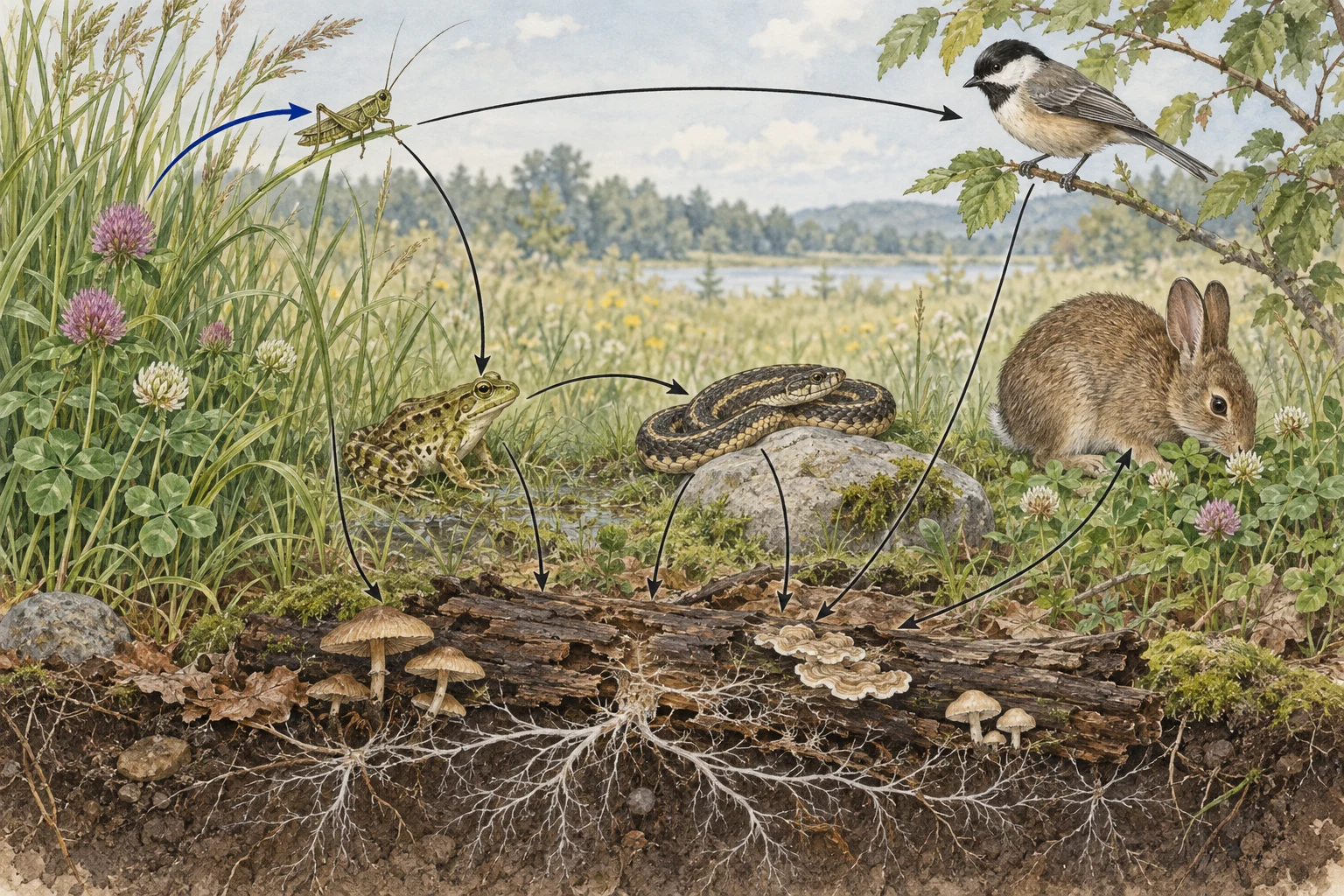
This guide walks the systems in that order, with a practice generator standing at each diagram you'll be asked to draw or label.
Food Chains, Food Webs, and the 10% Rule
A food chain is one path: producer, then primary consumer, then secondary, then tertiary. Producers are autotrophs that make their own food, consumers are heterotrophs that must eat something else. Simple enough to draw, and, as a rank-one ecology lesson puts it bluntly, "not a very good model," because a real snake eats rabbits and birds too. Ecosystems run food webs, several chains crossing.
Stack the same chain vertically and you get the energy pyramid, where the arithmetic surprises everyone. Give the plants 10,000 kilocalories. Primary consumers store about 1,000 of that. Secondary consumers store about 100. Roughly 10% carries up each trophic level, and the rest leaves as heat or passes through undigested. That single ratio explains why apex predators are rare and why a pyramid can never be top-heavy.
The Food Chain and Food Web Practice Generator builds diagrams for you to trace and label, arrows included, which is the exact skill tests grade. One group is missing from most drawings, though: decomposers. Bacteria and fungi eat the dead, and as the lesson notes, if you drew them in properly, every arrow in the web would eventually point at them. Ecology questions like these also run through our biology practice questions, sorted by topic.
Pull One Thread and the Whole Web Moves
Remove the grasshoppers and everything above them goes hungry. You'd predict that much. The lesson's sharper example runs the other way: remove the apex snake, frogs boom unchecked, and then the frogs starve because there aren't enough grasshoppers to go around. Prey species suffer from losing their predator, which is the kind of question that separates B students from A students.
- Biodiversity is the variety of organisms in an area, and it's what buys an ecosystem resilience, since a snake with three prey options survives losing one. The Biodiversity and Ecosystem Services Explainer connects that variety to the services ecosystems hand humans for free.
- Populations don't grow forever. Put the ceiling an environment imposes through the Carrying Capacity Population Ecology Solver and the limit stops being abstract.
- Not every relationship is predator and prey. Mutualism, commensalism, and parasitism get sorted by the Mutualism and Symbiosis Practice Generator.
- Ecosystems also change over decades, from bare rock or burned ground to mature forest, a sequence the Ecological Succession Explainer walks stage by stage.
- Climate and area size decide which organisms live anywhere, which is the biome question. For the adaptations each biome demands, run the Desert Ecosystem and Biome Comparison Practice Generator.
The Three Cycles: Matter Goes in Circles, Energy Doesn't
Energy enters as sunlight and leaves as heat, a one-way trip. That sunlight is hydrogen fusion from a star in the long middle of its life cycle. Matter has nowhere to go, so it cycles, and your course will test three of them as labeled diagrams.
| Cycle | The moves you'll be asked to label | The generator |
|---|---|---|
| Water | Evaporation, condensation, precipitation, collection, transpiration | Water Cycle Practice Generator |
| Carbon | Photosynthesis, respiration, decomposition, combustion, ocean uptake | Carbon Cycle Diagram Practice Generator |
| Nitrogen | Fixation, nitrification, assimilation, denitrification | Nitrogen Cycle Diagram Practice Generator |
That beats any printable water cycle worksheet, because a generated diagram arrives with fresh labels every run instead of the same six blanks your class filled in last year. Water underground gets its own treatment from the Groundwater and Aquifer Flow Practice Generator, which covers the invisible leg of the water cycle that most diagrams shrink to a single arrow.
Weather Is Today, Climate Is the Pattern
Weather versus climate is the distinction your course opens with and half the class still misses on the final: weather is what the atmosphere is doing this afternoon, climate is the average of decades. Both come down to heat and moisture moving.
Reading the sky starts with instruments and symbols, so the Weather Map Symbols Reading Practice Generator drills fronts, isobars, and station models until a forecast map is legible at a glance. Humidity questions run on one calculation. The Dew Point and Humidity Calculation Practice Generator handles the number that decides fog, frost, and whether the air feels heavy to you.
Oceans are the planet's other heat conveyor, moving warmth from equator to pole in currents that set the climate of whole continents. The Ocean Current Pattern Practice Generator maps those loops and the winds that drive them.
The Human Side: Systems With People In Them
The greenhouse effect is what keeps the planet livable and, in excess, what changes it. The Greenhouse Effect Practice Generator works the mechanism itself, incoming shortwave radiation, outgoing longwave, and the gases that intercept it, which is the physics under every climate headline.
Two tools make it personal rather than abstract. The Carbon Footprint Calculation Practice Generator turns your own driving, electricity, and diet into numbers you can total. The Renewable vs Nonrenewable Energy Classification Practice Generator sorts energy sources by whether the supply refills on a human timescale, the distinction most energy-policy questions rest on.
| Option | What you get | Best for | Skip if |
|---|---|---|---|
| A printable diagram worksheet | The same blanks, forever | One quick homework hand-in | Your class already used it, and answers circulate |
| Wikipedia, NOAA, NatGeo | Authoritative explanations of each system | Understanding a concept properly the first time | Reading isn't recall, you still need to draw it from memory |
| The generators above | Fresh diagrams and problems on the system you name | Repeated practice before a unit test | You haven't met the vocabulary yet, read first, then drill |
Keep one running diagram log in a Dock Editor document, one page per system, with the arrows you got backwards noted in your own words. That page is the whole unit review by exam week, and your first seven days there are free.
Take the ecosystem outside your window and sketch its web tonight, four organisms minimum, arrows pointing toward whoever eats. If you can't place the decomposers, you've found your first gap. Rocks follow arrows too, and our rock cycle guide shows the paths the textbook diagram leaves out. Rocks, minerals, and the rest of the earth science bench are waiting in the education prompt library.