Every star's death is scheduled at its birth, and the schedule reads backwards from what you'd guess: the biggest stars live the shortest lives. One number, mass, decides whether a star retires quietly as a cooling ember or detonates in an explosion that briefly outshines its whole galaxy and forges the atoms you're made of.
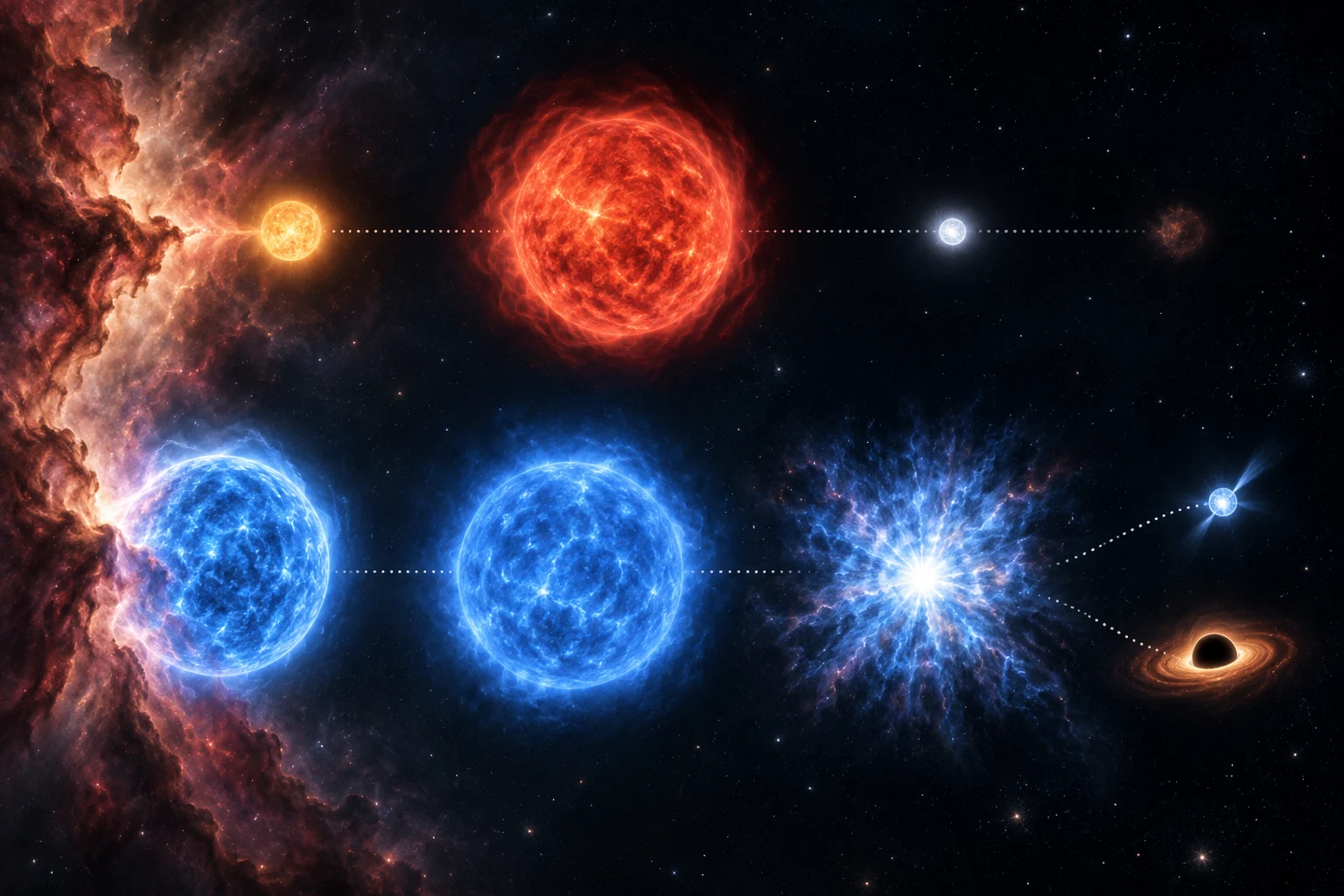
That fork makes the life cycle of a star the rare school topic that's also a creation story. Here's the full cycle stage by stage, with an explainer prompt for each, and the cosmic scale that puts it in context.
Birth: A Cloud Falls Into Itself
Stars begin as a stellar nebula, a cloud of dust and hydrogen gas. Gravity spends millions of years spiraling it inward, the collapsing gas heats to millions of degrees as a protostar, and a star officially ignites when hydrogen nuclei begin fusing into helium.
Then comes the long middle: the main sequence, where, as the rank-one video on the topic puts it, the outward pressure from fusion "counteracts the force of gravity." That balance holds for anywhere from 10 million to 10 billion years, and our Sun is sitting in the middle of it right now.
- The Nebula Types Explainer covers the clouds where it all starts, from stellar nurseries to the remnants dying stars leave.
- The Stellar Life Cycle Explainer walks the whole sequence at your grade level, which makes it the companion tool for this entire article.
The Fork: Mass Writes the Ending
What happens after the main sequence depends on the star's size, and the two paths share nothing past the first step:
| Stage | Sun-size star | Massive star |
|---|---|---|
| Fuel runs low | Swells into a red giant | Swells into a super red giant |
| Fusion ends | Collapses gently | Collapses and rebounds as a supernova |
| Corpse | White dwarf, cooling for billions of years | Neutron star, or a black hole if heavy enough |
| Final state | Black dwarf, cold as space | The densest objects in the universe |
The types of stars you see cataloged, red dwarfs, blue giants, yellow stars like ours, are mostly snapshots of different masses at different stages, and the Stellar Classification Explainer decodes that letter-and-number system.
The Quiet Ending: Red Giant, White Dwarf, Dark
When a Sun-size star exhausts its hydrogen, gravity wins temporarily, the core collapses and reheats, helium starts fusing into heavier elements, and the outer layers balloon. When our Sun reaches this red giant stage, it's expected to swell far enough to engulf the three inner planets, Earth included, though not for around five billion years.
When fusion finally stops, the star collapses into a white dwarf, a hot remnant that spends billions of years cooling toward black dwarf status, an ember, in the video's phrase, "as cold as the empty space that surrounds it."
The Loud Ending: A Supernova Forges Everything
A massive star burns hotter and empties its tank far faster, which is the backwards-lifespan rule from the top. Its collapse doesn't end quietly: the implosion rebounds as a supernova, an explosion that can outshine every other star in its galaxy for weeks.
The supernova is also the universe's foundry. Ordinary fusion can only build elements up to iron, and the extreme heat and pressure of the explosion forge everything heavier, then scatter it across space. The gold in jewelry and the iodine in your body came from exactly this. Stardust isn't a metaphor.
The Corpses: Neutron Stars and Black Holes
What the supernova leaves behind depends, once more, on mass. Electrons get crushed into protons, leaving a neutron star, matter packed to city-size density. And if the remnant is heavy enough that gravity keeps winning, it collapses past every known limit into a black hole, an object whose gravity is so strong that light itself can't escape.
That's the real answer to how black holes are formed: they're the final stage of the biggest stars' life cycle, not cosmic vacuum cleaners that wander around eating things. For decades astronomers could only detect them by their pull on nearby stars, until the Event Horizon Telescope produced the first direct image of one in 2019. The Black Holes and Event Horizons Explainer covers the facts, the spaghettification and the open questions at the edge of what's known, at homework depth.
The Scale Around the Cycle
Star death makes more sense against the distances involved, and the vocabulary questions students search most all live here. A light year is a distance, not a time: how far light travels in one year. Numbers this size get written in scientific notation, which is exponent rules applied to real quantities. Galaxies hold billions of stars running this cycle at once, and current estimates put the observable universe's galaxy count in the hundreds of billions or more.
- The Cosmic Distance Ladder Explainer explains how astronomers measure those distances rung by rung.
- The Galaxy Classification Explainer sorts spirals from ellipticals, and the Big Bang and Cosmology Timeline Explainer places all of it on the universe's own life cycle.
- The Dark Matter and Dark Energy Explainer handles the humbling part: the stars' whole story plays out in roughly five percent of what the universe is made of.
- The Telescopes and Spectroscopy Explainer answers the how-do-we-know question underneath every fact above, since starlight's spectrum is where the evidence lives. The redshift in those spectra is the Doppler effect applied to light, explained in our Doppler effect guide.
Where Planets Enter the Story
Our own solar system condensed from a nebula seeded by earlier supernovas, which is why a rocky, iron-cored planet like Earth exists at all. What that rock has done since is the story of the rock cycle. The Solar System Formation Explainer tells that chapter, the Habitable Zone Explainer covers why distance from a star decides livability, and the Orbital Mechanics Formula Solver does the math homework side when the class turns quantitative.
| Resource | What it gives you | Best for | Skip if |
|---|---|---|---|
| NASA and ESA sites | Authoritative facts and images | Citations for a report | You need it explained at your level, they write for everyone |
| A documentary or video | The awe and the visuals | First contact with the topic | The test is Friday, you need practice not ambience |
| An explainer prompt | The concept at YOUR grade depth, with questions answered | Homework, test prep and paper research | You need a primary source to cite, pair it with NASA |
Report drafts, explainer answers and the quiz questions you generate can all sit in one document per unit inside the Dock Editor, which costs nothing to try for a week.
Tonight, if the sky's clear, find the brightest star you can and place it on the table above: it's mid-cycle, fusing hydrogen against its own gravity, and its ending is already written in its mass. Then run the Stellar Life Cycle Explainer at your grade level and let the homework version feel this easy. The rest of the science explainers live in the education prompt library.