The Doppler effect is the one physics phenomenon you've already heard: a siren climbs in pitch as it approaches, then drops the moment it passes. It's also where physics class changes character. First semester was blocks on ramps. Second semester is waves, heat and the modern physics that ends in quantum mechanics, and the formulas stop looking like anything from daily life.
This hub covers that whole second act: the Doppler effect properly explained, then a solver for each unit from refraction to radioactive decay. The mechanics semester has its own guide at kinematic equations. Electricity and magnetism, taught first in some courses and second in others, live in our series and parallel circuits guide.
Why the Siren Bends: Waves Meet Motion
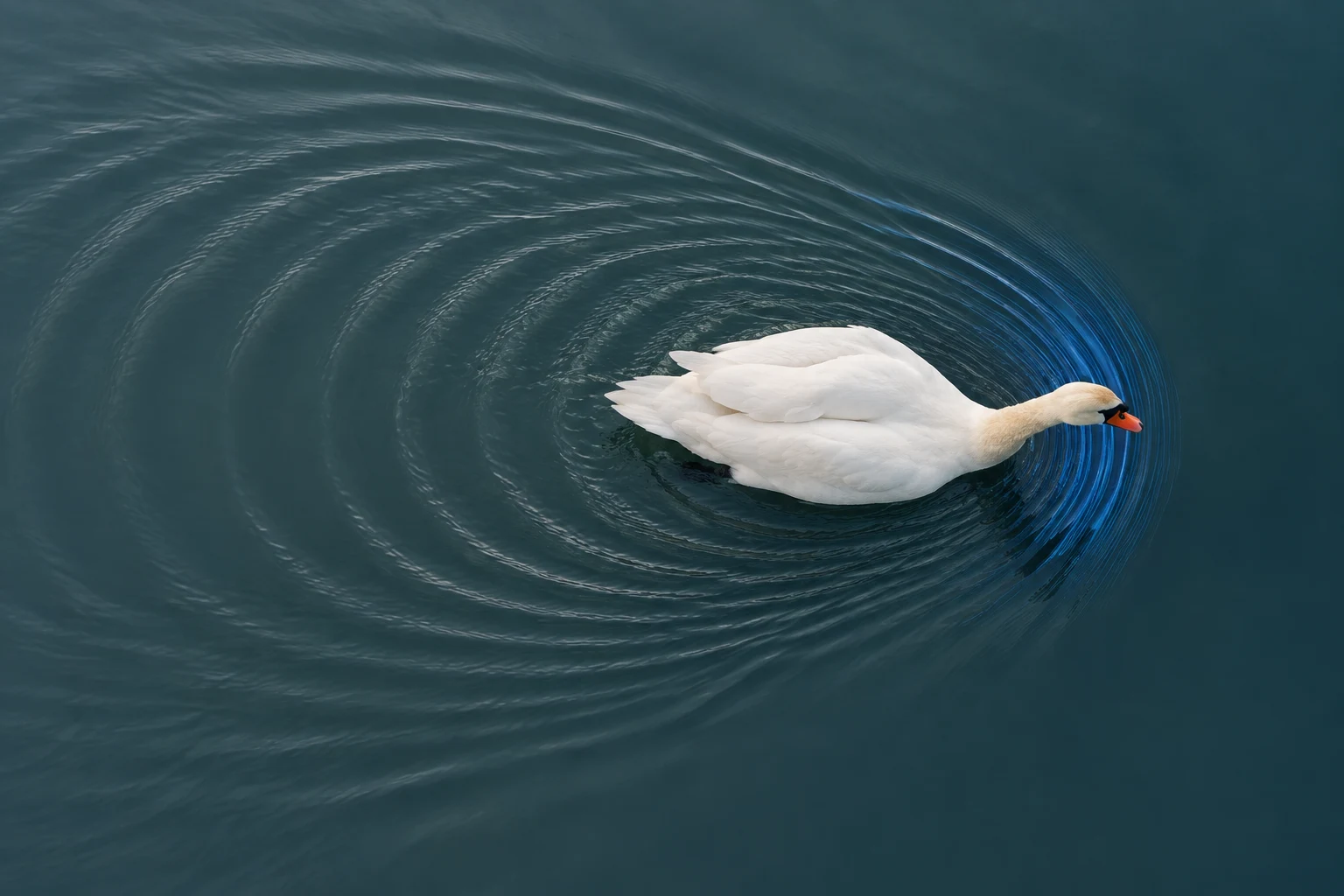
A stationary source sends out waves in even rings, so a listener hears one steady pitch. Move the source and the rings ahead of it start, in the words of the AP physics walkthrough on the topic, "bunching up," while the rings behind it are "spreading out." Bunched waves arrive more often: higher frequency, higher pitch. Spread waves arrive less often: the drop-off after the car passes.
The walkthrough's best image is a swan. You can tell which way a swan is swimming from a photo alone, because its bow waves bunch in front and spread behind. Same physics, visible in water.
Two details decide exam points. First, the effect works for a moving observer too, not only a moving source: run toward a wave source and you meet wave crests more often. Second, the sign conventions in the Doppler formula depend on who moves toward whom, and that bookkeeping is where most lost points hide. The Doppler Effect Solver walks the setup with your numbers and keeps the signs honest.
The effect scales up spectacularly. Light from a receding source stretches toward the red, and Hubble's observation that all distant light is red-shifted, called in the walkthrough "one of the greatest discoveries ever," is how we know the universe is expanding. The same starlight spectra tell astronomers where a star sits in its life cycle. The same shift in radio waves is how weather radar reads a storm and how a speed gun reads your car.
The Wave Toolkit Underneath It
Every Doppler problem stands on wave basics: speed equals frequency times wavelength, and the wavelength formula rearranges from there. That relationship plus a handful of others run the whole unit.
- The Wave Properties Explainer covers amplitude, period, frequency and the wave equation with your textbook's notation.
- The Wave Speed on a String Solver handles the tension-and-density problems labs are built on.
- The Standing Wave and Resonance Solver does harmonics, nodes and the organ-pipe questions, while the Simple Harmonic Motion Solver takes the springs and pendulums that oscillation problems cycle back to.
Light: Refraction, Lenses and the Spectrum
Optics is the unit where a straw looks bent in a glass of water. Snell's law governs that bend. The Snell's Law Refraction Solver ties the angles to each medium's refractive index and runs the algebra both directions, critical angle included. The Optics Lens and Mirror Solver takes the image-distance and magnification problems that follow.
Beyond visible light sits the full electromagnetic spectrum, radio to gamma, and the Electromagnetic Spectrum Practice Generator drills the wavelength-to-frequency conversions and band ordering the unit test always asks.
Heat: The Thermodynamics Equations That Run Engines
Thermodynamics compresses into a few laws with famous consequences: energy is conserved (the first law), entropy grows (the second), and no engine escapes either. Ecosystems don't escape them either, which is why energy leaks away at every level of a food web.
- The Laws of Thermodynamics Practice Generator builds problems on all of them, first law of thermodynamics energy accounting included.
- The Thermal Expansion Formula Solver plus the Heat Transfer Conduction Solver cover the two calculation types the unit leans on, and specific heat capacity problems live inside the calorimetry family both touch.
- Gas behavior gets the Ideal Gas Law Solver, which serves physics and chemistry with the same PV equals nRT.
Modern Physics: Where the Rules Change
The last unit rewrites the previous ones. Light arrives in packets, atoms decay on probabilistic clocks, and electrons stop having positions.
- The Photoelectric Effect Solver handles work function and photon energy problems from the experiment that won Einstein his Nobel Prize.
- The Half-Life Decay Solver runs the half life formula forward and backward, from carbon dating to medical isotopes, while the Nuclear Decay Types Explainer sorts alpha from beta from gamma. Every half-life answer is a power of one half, so shaky exponent rules cost points here first.
- The Schrodinger Equation Explainer gives a plain-language account of quantum mechanics' central equation, at the depth your course requires.
Solvers, Sheets and Videos Each Earn a Slot
| Resource | What it gives you | Best for | Skip if |
|---|---|---|---|
| A formula sheet | Every equation, zero context | The night-before scan and the allowed cheat sheet | You can't yet tell which formula a problem wants |
| A video explainer | The intuition, like the swan | First contact with a concept | You're past intuition and stuck on problem 7 |
| A solver prompt | Setup and algebra walked with YOUR numbers | Homework where the method won't click | You haven't attempted the problem once yourself |
The Formula Sheet Generator builds the sheet column of that table for exactly your syllabus, units you covered, notation your teacher uses.
Inside the Dock Editor, each unit's solver work, formula sheet and wrong-answer log can live as one running document, and trying the full setup costs nothing for your first week.
The next siren that passes you is a free physics demonstration: pitch up, pitch down, wavefronts bunching and spreading exactly as drawn. When the homework version shows up with numbers attached, start with the Doppler solver above and work outward through the units. The rest of the science shelf is in the education prompt library.