ROYGBIV works because somebody already did the hard part. The rainbow got its acronym, math got PEMDAS, music got Every Good Boy Does Fine, and those hooks have carried students for generations. Then your exam hands you a list nobody famous ever bothered with, and the method that worked all through school suddenly has no hook to give you.
That's the real problem with every mnemonic devices page on the internet. They catalog the types and re-serve the same worked examples, which teaches you what a mnemonic is and leaves you alone with your actual list. Making the hook yourself is a skill, it's learnable, and when you'd rather skip to the answer, there's a generator for it.
Memorization Reduces to Three Steps
The clearest system-level framing comes from a doctor's memorization guide with over a million views, built from testing every technique across med school: nearly every one is some combination of visualize, structure, repeat.
Visualize, because brains hold images far better than words or numbers. Say "apple" and you see the fruit, not the letters. Structure, because loose images need something linking them: a story, an acronym, a rhyme, the rooms of your house. Repeat, because even a linked image fades without recall practice.
Every famous mnemonic is steps one and two done for you, once, by someone else. The tools below do them for whatever you're holding.
Pick the Hook Type Before You Build
| Tool | What it does | Best for | Skip if |
|---|---|---|---|
| A famous mnemonic (PEMDAS, ROYGBIV) | A ready-made hook, pre-tested by generations | The standard lists every class memorizes | Your list isn't one of them, which is most lists |
| The Mnemonic Device Generator | Builds candidate hooks for the exact list you paste | Terms with no famous hook: your drug class, your dates, your formulas | The list is ordered and long, where a palace works better |
| A memory palace | Ordered images placed along a route you know | Long sequences, speeches, decks of cards | You need it tonight and haven't built a route before |
Generators Cover the Three Classic Hook Shapes
- The Mnemonic Device Generator is the general builder: paste the list, get several hooks in different styles, keep the one that sticks on first read.
- The Acronym Generator for Memorization works the PEMDAS shape specifically, turning first letters into a pronounceable word or phrase.
- The Rhyme Mnemonic Generator builds the "i before e" shape, which survives longest for rules and exceptions.
One craft note from the med-student guide: the stories that stick are the ones with action and humor in them. A bland image is a forgettable image, so when a generated hook feels flat, regenerate toward the ridiculous.
The Memory Palace Owns Ordered Material
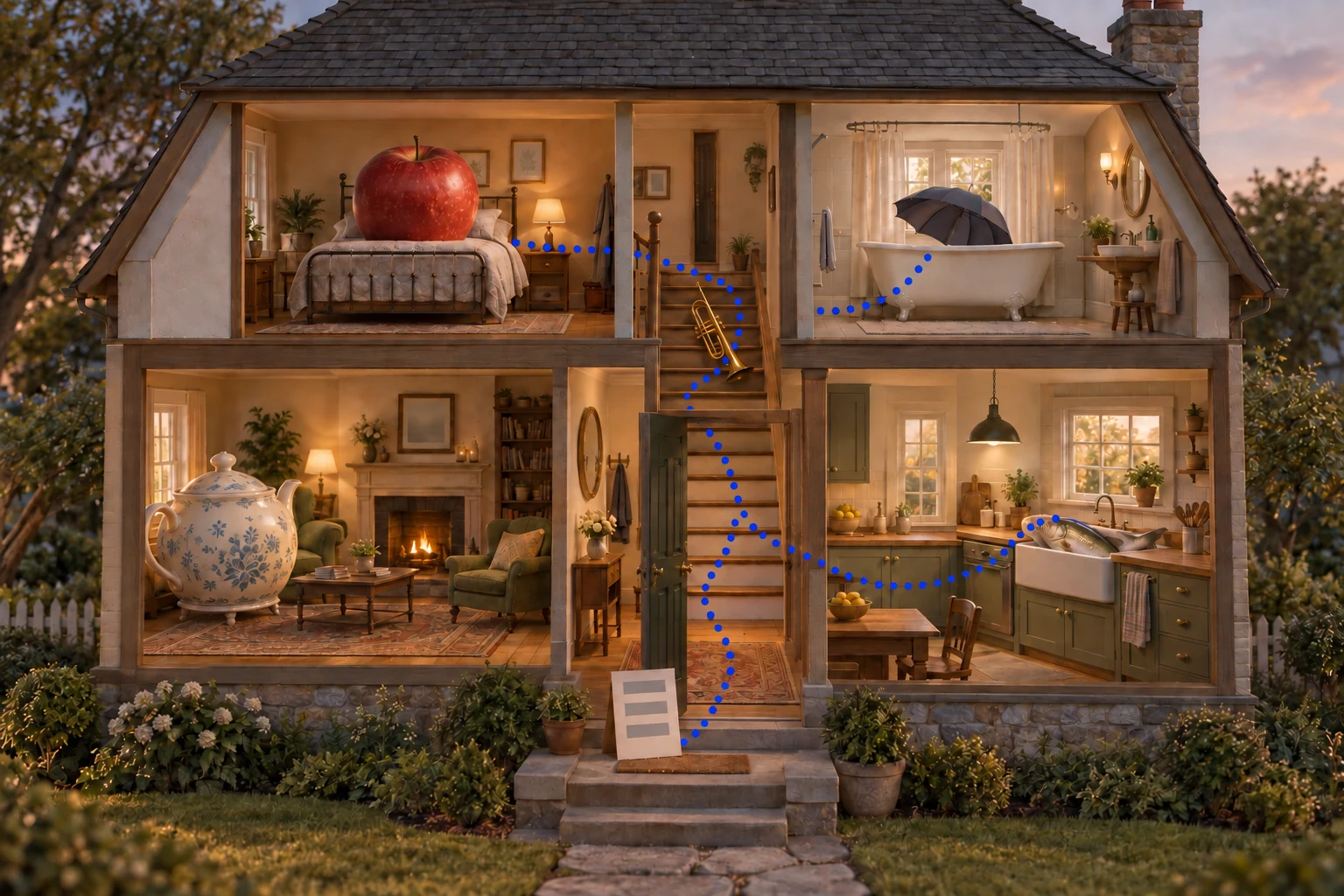
The method of loci, the palace, is the oldest technique on the page and still the strongest for sequences. Place one vivid image per item along a route you already know cold, your bedroom, your walk to class, then retrieve by walking the route. The story method is its portable cousin: chain the images into a running narrative, and, as the guide puts it, you only need to remember the first item and the story flows from there.
Chunking rides along with both. A phone number isn't ten digits, it's three chunks, and any long list gets easier the moment you group it. Memorizing a speech works the same way: one image per beat, placed along a route, rather than word-for-word cramming.
There's no palace generator, and that's deliberate. The route has to be yours or the placements don't hold. What the Mnemonic Device Generator can do is supply the vivid images for each item, which is the step people stall on.
A Hook Nobody Revisits Still Fades
Step three is where mnemonics quietly fail. The hook gets you through tomorrow's quiz, then decays like everything else unless it's revisited on a schedule. Why spacing works, and the evidence behind it, is in our how to study for exams guide.
- The Spaced Repetition Guide builds the review calendar, widening the gaps as the material firms up.
- The Active Recall Study Guide converts your notes into self-testing questions, because retrieving is what strengthens the trace.
- Flashcards combine both, and the guide's sharpest tip is to put your generated images and stories on the cards themselves. The Flashcard Generator builds the deck, the Picture Flashcard Generator builds the image-cue variant, and the Flashcard and Quiz Combo Generator adds the quiz layer. The full card-building workflow has its own guide in our flashcard maker rundown.
Med Students Run This System at Industrial Scale
No field leans harder on manufactured hooks than medicine. The transcript's own worked example is the cranial nerves, twelve of them, ordered, arbitrary, and non-negotiable, memorized as a story that starts with a nose. Whole commercial platforms exist to turn pharmacology into storyboards. The exams at the end of that road have their own guides: the MCAT in our GRE, GMAT, LSAT and MCAT comparison, and nursing licensure in our NCLEX 2026 guide.
For that volume, the Anatomy Flashcard Generator and Pharmacology Flashcard Generator build the structure-by-structure and drug-by-drug decks, and the hooks ride on top. Print runs come from the Printable Flashcard Template Maker when screens are the distraction.
Put the Three Steps on a Calendar
A hook per list, cards carrying the hooks, reviews on widening gaps: that's the whole system, and the Study Plan Generator schedules it backwards from your exam date.
Keep it in one place. The Dock Editor holds your lists, your generated hooks and your review schedule in a single document, and the 7-day free trial is enough to build the system for one exam.
Start with the list that's been refusing to stick. Paste it into the Mnemonic Device Generator, take the least sensible hook it offers, and say it out loud twice. If it makes you roll your eyes, it's working, and tomorrow you'll still have it. The rest of the study set lives in the education prompt library.