Every question Google attaches to the word "prepositions" is a counting question. How many are there, 10, 20, 25, or 150? People want the list, and the internet has obliged with a list on every reference site.
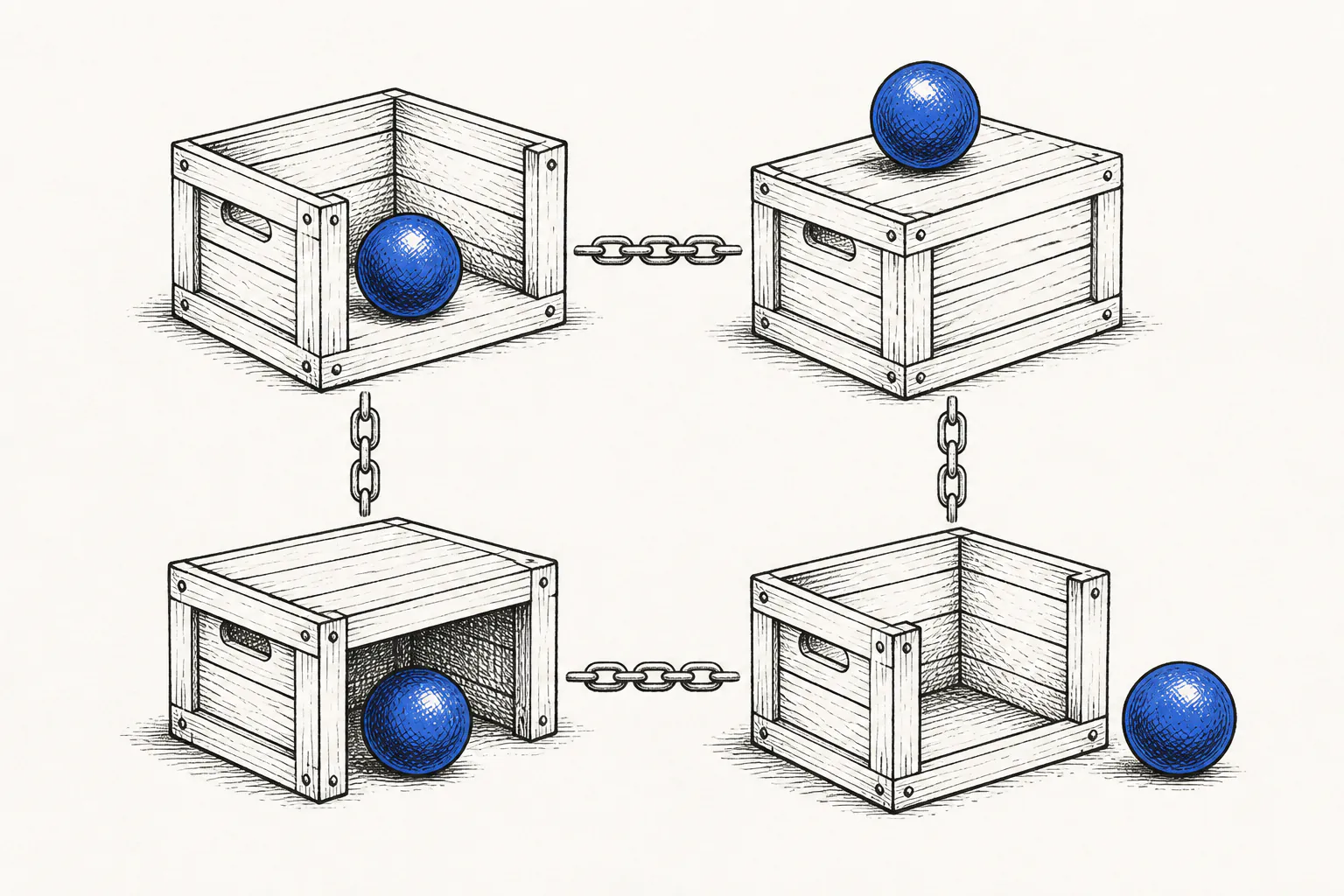
You don't get stuck because you can't name a preposition. You get stuck choosing between two you already know.
The viewing numbers prove it. A thorough video called "Learn 150 English Prepositions with examples" has a few thousand views. A video about whether it's IN or ON has nearly seven million. The list was never the thing anybody needed. The choice was.
Nobody Fails Because the List Was Missing
Rebecca from engVid teaches prepositions through what she calls a diagnostic lesson, and her reason for the format is the reason reference pages don't work:
"Sometimes you're using different prepositions, but you're not really sure if it's right or wrong, and other times you're using it and you're sure it's right, but it's actually wrong, and you don't want to find out in an exam or some other important situation."
Being confident and wrong is the failure mode. A list can only help someone who already knows to look something up, and by definition that isn't you in the case that matters. Something has to test you before you find out the expensive way.
Her method is three steps she abbreviates F.U.N.: find out what's wrong, understand how to correct it, then nail it with practice. Everything below is arranged for that order.
| Stage | What you need | Best for | Skip if |
|---|---|---|---|
| Find out | A diagnostic that tests you on pairs you think you know | Before any studying, because your guesses about your weak spots are wrong | You have marked-up work from a teacher already |
| Understand | The rule behind the one you missed, not all 150 | The specific pair that caught you | You already know the rule and keep slipping anyway |
| Nail it | Unlimited fresh items on that one pair | Turning a rule you can recite into one you use without thinking | You haven't diagnosed anything yet |
In a Taxi, On a Train
English with Lucy opens on the two questions that expose the whole problem: why do you get in a taxi but on a train, and why is it in the morning but at night? No principle covers both. The pairing is a fact about English, learned per case.
- Time and place carry different rules for the same three words, which is why they get taught together and confused together. Feed your own sentence to the Prepositions of Time and Place Explainer and it explains the choice you made rather than listing all the options.
- Rebecca's tested sentence is "I've worked here _____ three years," where the answer is
for. Her rule:fortakes a period of time (for three years, for three months),sincetakes a point in time (since November, since 2012, since the summer). Worth drilling on your own writing with the ESL Grammar Practice Generator, which builds fresh items on one pattern at a time. - "In this street" or "on this street"? "On this floor" or "in this floor"? Those live in the same confusion set, and the Grammar Error Correction Generator produces sentences with planted errors so you practice catching rather than reciting.
- Once a preposition has a noun attached, it's a unit that moves around the sentence, and mistaking it for the subject is how agreement errors start. The Prepositional Phrase Identifier marks those units in your own paragraph.
Conjunctions Decide Where the Comma Goes
The practical payoff isn't the definition. Which kind of conjunction you used determines your punctuation, so this is where a grammar label earns its keep.
- Two independent clauses joined by
and,but, orsotake a comma before the conjunction. The Coordinating Conjunction Identifier finds them, which is the check that stops comma splices. Although,because,while, andsincedo something different: they make the clause they open dependent, and the comma rule flips depending on which half comes first. That's the Subordinating Conjunction Identifier.- Reading a passage and labeling every sentence as simple, compound, complex, or compound-complex is the fastest way to see that all your sentences are one shape. The Sentence Types Identifier does that labeling.
Gerunds and Participles Are the Same Word Doing Two Jobs
Gerunds and participles draw more confusion than any other pair on this list, and the two words look identical on the page. Both end in -ing. One is a noun, one is describing something. That's the whole distinction and it's worth ten minutes.
- Gerund Identifier is the most-used prompt in this set.
Swimming is harduses a noun.The swimming pooluses a describer, and it's the same eight letters either way. - The Participle Identifier covers the other job, including past participles, which is where the dangling-modifier errors come from.
- Do you
enjoy to swimorenjoy swimming? Neither rule nor logic decides it, the verb does, and there's no list of every verb worth memorizing. The Gerund vs Infinitive Explainer works it against your own sentence. Can,could,should,might,must. These carry obligation and probability rather than action, and they're the highest-value grammar term in this cluster commercially (a $6.72 cost per click says the ESL market pays for it). The Modal Verbs Explainer handles them.- Is the verb doing something or connecting something? The Linking and Helping Verb Identifier separates those, which is the prerequisite for getting
whoandwhomright later.
A, An, The: The Words With No Rule Your Language Shares
Articles are the single hardest thing about English for speakers of languages that don't have them, and native speakers never notice the difficulty because they never learned it consciously.
- The Articles (A, An, The) Checker is the second most-used prompt in this set, which tracks with how much trouble it causes. Paste a paragraph and it flags every missing or extra article with the reason.
- Half of article errors are really noun errors.
Advice,information, andfurnituredon't takeanor a plural, and knowing which nouns behave that way fixes both problems at once. That's the Count and Noncount Nouns Explainer.
When You Do Need the Labels
Grammar terms are worth learning when they let you fix something. These four qualify.
- The Parts of Speech Identifier tags every word in your own sentence, which beats memorizing eight categories in the abstract. Use it on text you wrote.
- Find the real subject and the real verb and most agreement errors resolve themselves. The Compound Subject and Predicate Identifier handles the case where either one is doubled.
- Who received the thing, and who received it on whose behalf? The Direct and Indirect Object Identifier separates those, and it's the grammar behind pronoun case.
- A long phrase sitting between the subject and the verb makes you match the verb to the nearest noun instead of the actual subject. The Subject-Verb Agreement Checker catches exactly that.
Sentence diagramming is out of fashion in classrooms and it does one thing well: it makes the shape of a sentence visible instead of theoretical. If the identifiers above feel abstract, diagramming one paragraph by hand is a decent afternoon.
What to Do Tonight
If you're studying grammar for a test rather than for your writing, the prompts for students and teachers cover the drilling side, and the 21 AI writing tools rundown covers which ones check grammar properly.
Keeping your missed-pair log next to the writing that produced it is the difference between a list you reread and a list that shrinks. The Dock Editor is free for 7 days and runs any of these prompts against the document already open.
Start with the diagnostic, not the list. Write out five sentences you're unsure about, run one prompt on them, and you'll have a shorter and more useful list than any reference page could give you. Browse every writing prompt for the rest of the grammar set.