An objective summary restates a text's central idea and key details in your own words, with zero opinion attached. You keep every judgment out, down to single adjectives. The facts of the text, compressed.
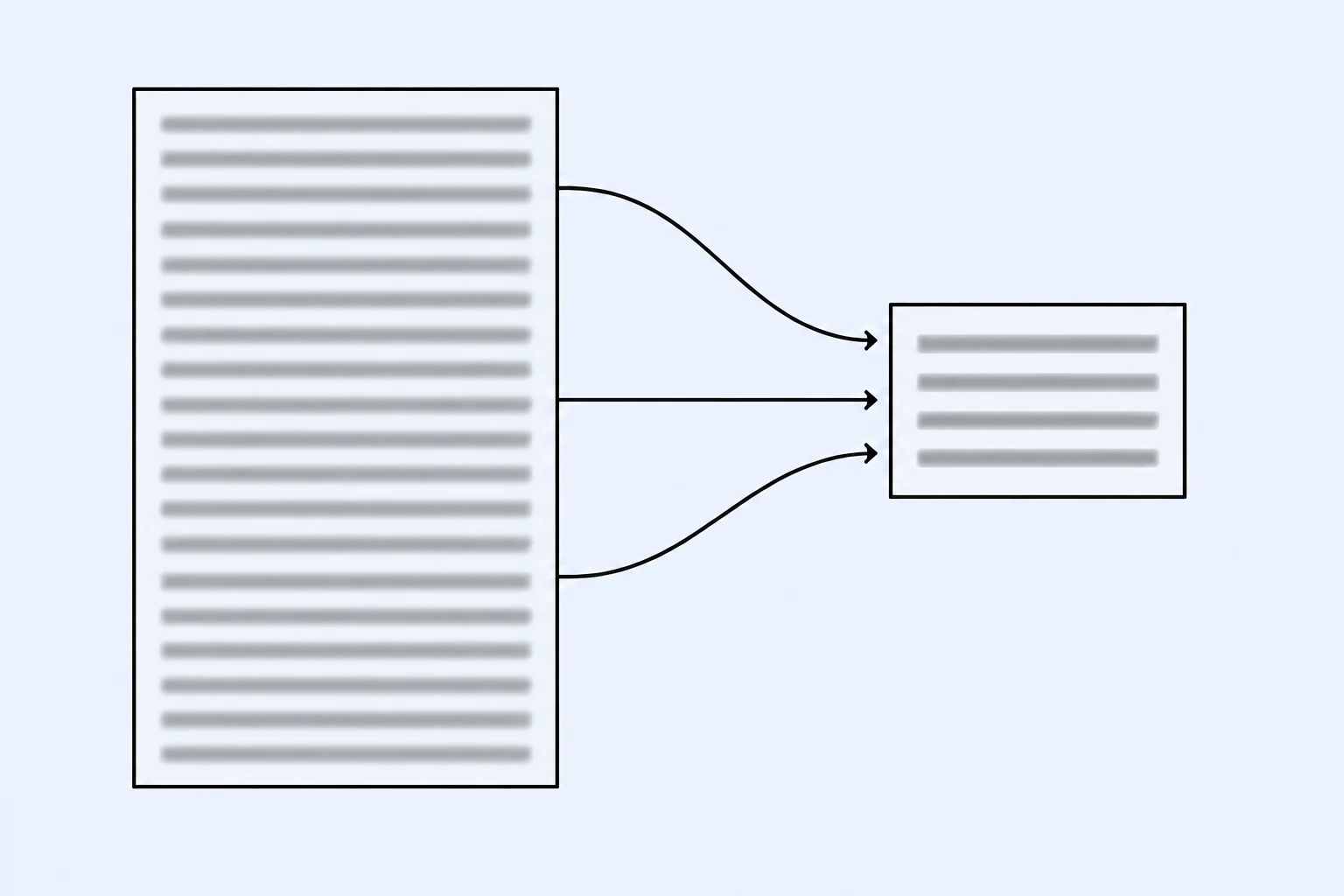
One adjective can sink it. Write "the author's fascinating study" and the summary stops being objective, because fascinating is your verdict, not the text's content. That single-word failure is why Common Core RL.7.2 names the skill "provide an objective summary of the text" instead of asking for a summary alone: the objective part is what gets graded.
What "Objective" Bans
The Iowa Reading Research Center draws the line cleanly: only information that comes from the text. Off-limits:
- Opinions. "The essay is convincing" grades the essay. Out.
- Judgment adjectives. Brilliant, boring, beautiful, weak. All verdicts.
- First person. "I think," "I liked," "it made me feel." The summary has no I.
- Your conclusions. If the text didn't say it, the summary can't. Inference belongs in analysis, not summary.
What stays: who, what, where, the central idea, and the details that carry it.
Write It in Five Steps
- Read the whole text first. Summarizing while reading produces a play-by-play, not a summary.
- Name the central idea in one sentence. What is the whole text saying? Not one paragraph, the whole thing.
- Pick the 3-4 details that carry the idea. The ones the text would collapse without. Everything else is trimming.
- Draft in your own words, present tense. "The author argues," not "the author argued." Borrowed phrasing is a paraphrasing problem before it's a summary problem.
- Strip the opinions. One hunting pass for adjectives and reactions. Every one you find, cut or replace with what the text says.
Five steps, and the fifth is the one the rubric watches.
- Stuck on step two? The Central Idea Finder names a passage's central idea and shows the textual evidence that develops it.
- Stuck on step four? The Paraphrase Tool restates a sentence in new words with the meaning intact, so borrowed phrasing doesn't slip in.
Run the Opinion-Leak Test
Could someone who hates the text sign off on your summary? That's the test. An objective summary of an essay you loved and an essay you hated should read at the same temperature.
Two versions of the same sentence:
Leaky: "The author makes an excellent case that school should start later, backed by impressive sleep research."
Objective: "The author argues that school should start later, citing sleep research on adolescent circadian rhythms."
The second version reports the claim and its support. Whether the case is excellent is the reader's problem, and the summary refuses to have an opinion about it.
Fiction and Nonfiction Ask for Different Summaries
Two templates cover both.
For nonfiction: central idea plus the key supporting details, in the text's order.
For fiction, teachers hand out the Somebody-Wanted-But-So-Then frame: somebody (character) wanted (goal), but (conflict), so (response), then (resolution). It walks the same arc as a plot diagram, conflict to resolution. One pass through that frame produces a plot summary with no room for "and it was thrilling."
- Filling in the frame by hand? The Graphic Organizer Generator builds a blank or pre-filled chart to sort the story's parts before you write.
- Summarizing a whole book? The Book Summary Generator produces a full-length summary to check your central idea against.
Here Is One Worked Through
Take a 900-word article arguing that community gardens reduce neighborhood food insecurity, with survey data from three cities and one grant-funding case study.
The objective summary: "The article argues that community gardens measurably reduce food insecurity in the neighborhoods that host them. Survey data from three cities show garden-adjacent households reporting fewer skipped meals. A case study of a Cleveland grant program traces produce output over two seasons. The author concludes that municipal funding is the main barrier to scaling."
Four sentences. Central idea first, then the evidence the argument leans on, then the text's own conclusion. Nothing about whether the argument works.
- Working from a news or magazine piece? The Article Summarizer pulls the key points out of a long article so you can confirm which details carry the argument.
Where Summaries Go Wrong
The adjective leak. Covered by the hunting pass in step five, and still the most common point loss.
The play-by-play. Ten sentences marching through the text paragraph by paragraph. A summary compresses around the central idea, and four to six sentences covers most school assignments.
The stealth copy. Phrases lifted straight from the text. Own words is part of the rubric, and it's the same skill paraphrasing trains.
Build the Habit Faster
Checking your own summary for leaks is hard because you agree with yourself. A summary writer produces a clean objective baseline to compare against, which makes your leaked opinions visible by contrast. For book-length assignments, a chapter summary generator holds each chapter to the same no-opinion standard, and the one-sentence book summary generator is the central-idea step as a standalone exercise.
Draft in the Dock Editor (free for 7 days) and run the opinion hunt with the text and your summary side by side in one document.
Next summary you write, do step five out loud: read it and ask of every sentence, "did the text say this, or did I?" The question sounds simple. It catches almost everything the rubric will.