Coming up with story ideas stopped being the hard part. A generator produces twenty premises in a minute, every prompt listicle holds a hundred more, and the working writer's problem quietly inverted: not finding an idea, but choosing the one that deserves the next year of your evenings.
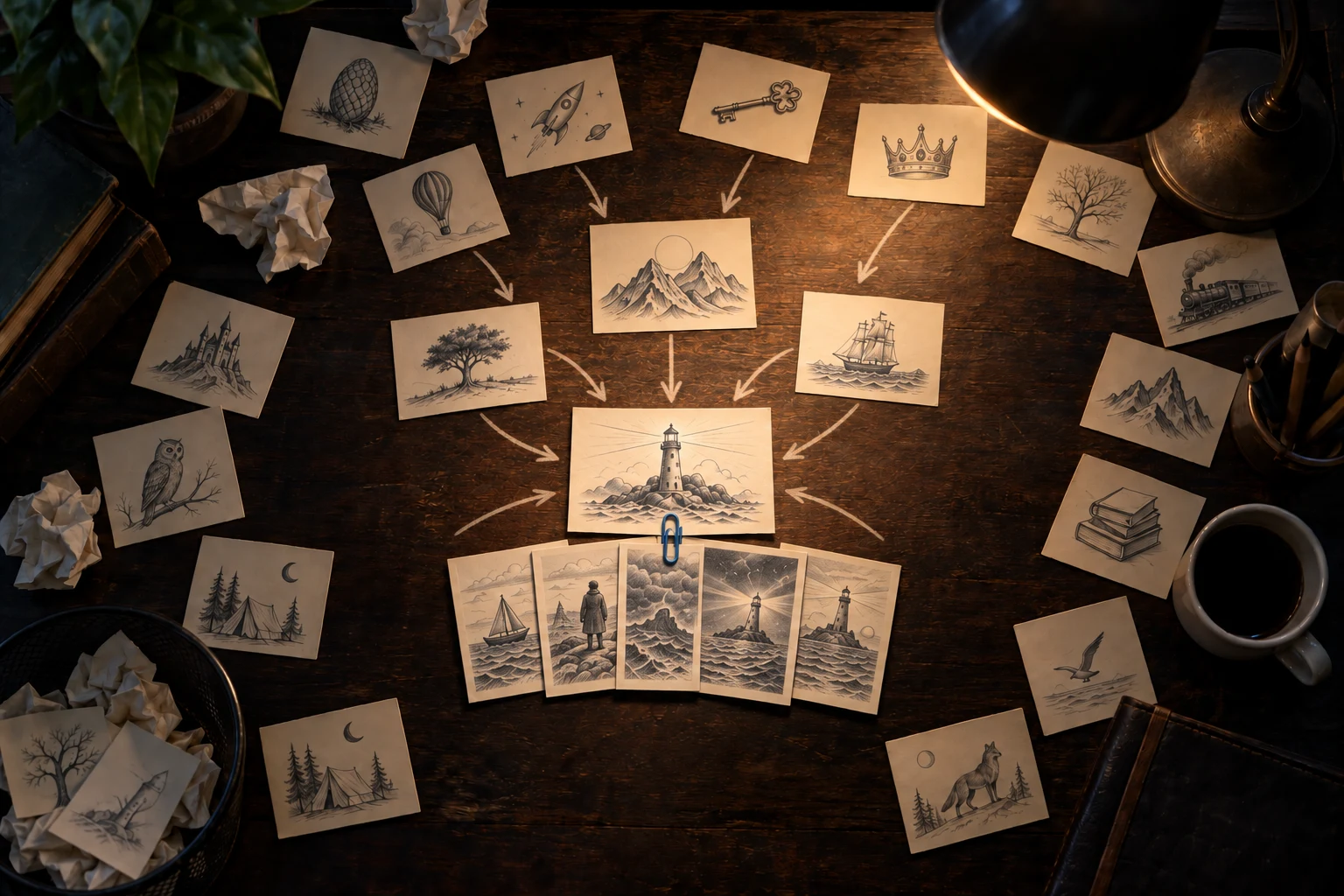
So this page does both halves on purpose. Generators for volume, because volume beats waiting for lightning. Then a selection method borrowed from a working book editor, because the expensive mistake in fiction is writing three hundred pages of the wrong premise.
Generate Twenty Before You Judge One
The classic prompt listicle hands you a random situation, and randomness is exactly its weakness: a stranger's premise with none of your obsessions in it. The generators work from constraints instead, your genre, your themes, your tone, which makes the output raw material rather than someone else's leftovers.
- The Story Idea Generator produces full premises, character plus conflict plus stakes, inside the genre you name.
- The Story Prompt Generator and the education-side Writing Prompt Generator build open-ended prompts, the second tuned for classrooms and daily practice.
- The Story Starter Generator skips the premise and hands you first lines, which suits writers who find ideas by writing rather than before writing.
| Tool | What it does | Best for | Skip if |
|---|---|---|---|
| A prompt listicle | A hundred random situations | Warmup sprints and writing exercises | You need a premise you'd stay married to for a year |
| A constrained generator | Premises built from YOUR genre and themes | Producing the twenty candidates worth testing | You already have the earworm idea, skip to testing it |
| The eight tests below | Kills the weak candidates | Choosing before you commit months | You're writing purely for practice, then nothing needs to survive |
Eight Tests Decide Which Idea Gets the Year
A book editor's idea-testing rundown is the best selection method we've seen written down, and two of its tests do most of the killing.
The dinner party test goes first: pitch the unwritten book in one sentence that "ignites the curiosity of your listener." The video's Hunger Games rewrite shows the bar: "To save her sister, a girl must murder 23 children on live TV while the rich place bets on who dies first." Most writers build that sentence after the manuscript. Building it before, the editor argues, "can save you years of your life."
The rest of the battery, fast: the right-person test (why you), the wow-factor test (what stands apart), the weight test (personal baggage is fuel, not liability), the town-versus-brick test (a first novel pitched as a 900-page epic with 27 main characters is a warning sign), the common-denominator test (comparable books must exist, and "no one has ever written this before" is a red flag, not a badge), and the forget-about-it test: "can you forget about your novel idea? Because if you can, you probably should." The earworms are the keepers.
The last one is the scene test, and it's the practical tiebreaker: list five specific scenes you're excited to write. Not "the climax." Specific ones. If you can't, the idea is a mood, not yet a story.
The Survivor Gets Developed, Not Just Admired
- The Character Development Builder turns the premise's people into wants, wounds and contradictions, the backstory layer plot grows from.
- The Story Synopsis Generator expands your dinner-party sentence into the page-long version, which is where plot holes surface cheaply.
- The Chapter Outline Generator lays the spine chapter by chapter along the plot mountain, and outlining is also where the scene test gets rerun honestly.
Dialogue Is Where Ideas Learn to Talk
How to write dialogue is its own craft question, and the working rules are stable: characters who want different things in the same room, speech that sounds distinct per person, and "said" doing the quiet work while the words carry the emotion. The Dialogue Writer drafts exchanges between your characters so you can hear whether they have voices yet, which is a test of the premise as much as of the lines.
Some Ideas Arrive Wearing a Genre
- The Fairy Tale Generator builds in the once-upon-a-time register, for children's writing or subversions of it. Writers who illustrate their own picture books can aim their sketch practice with our drawing ideas guide.
- The Quest Hook Generator serves game masters whose story ideas need to start at a tavern table tonight.
- The Choose Your Own Adventure Generator handles branching stories, and the Poetry Generator catches the ideas that were never prose to begin with. Songwriters often start from a chord progression instead of a premise, and the circle of fifths shows which chords pull toward home.
Fantasy and science fiction ideas come with a naming workload attached, and that entire lane, twenty-eight generators deep, lives in our fantasy name generators guide.
Package the Idea Like It Already Sold
Two prompts borrow the marketing department's tools for your own clarity: the Book Title Generator forces the premise into a shelf-ready phrase, and the Book Blurb Generator writes the back cover, which is the dinner party test in its commercial form. If the blurb reads flat, you've learned it early and for free.
The Dock Editor gives the surviving idea a home: premise, synopsis, outline and chapters in one document, with the free trial covering your first drafting week.
Run the sequence tonight. Twenty premises from the Story Idea Generator, the dinner party sentence for the three best, and the scene test on whichever one you keep thinking about while brushing your teeth. That one's the earworm. Write it. The rest of the craft stack waits in the writing prompt library.