Almost every music student can draw the circle of fifths and almost none can say what it's for. The wheel gets taped to practice-room walls, printed on posters, memorized for a quiz, and then sits there decorative. One music teacher's diagnosis is blunt: the circle is "amazingly powerful" and "a lot of people don't really understand how to use it."
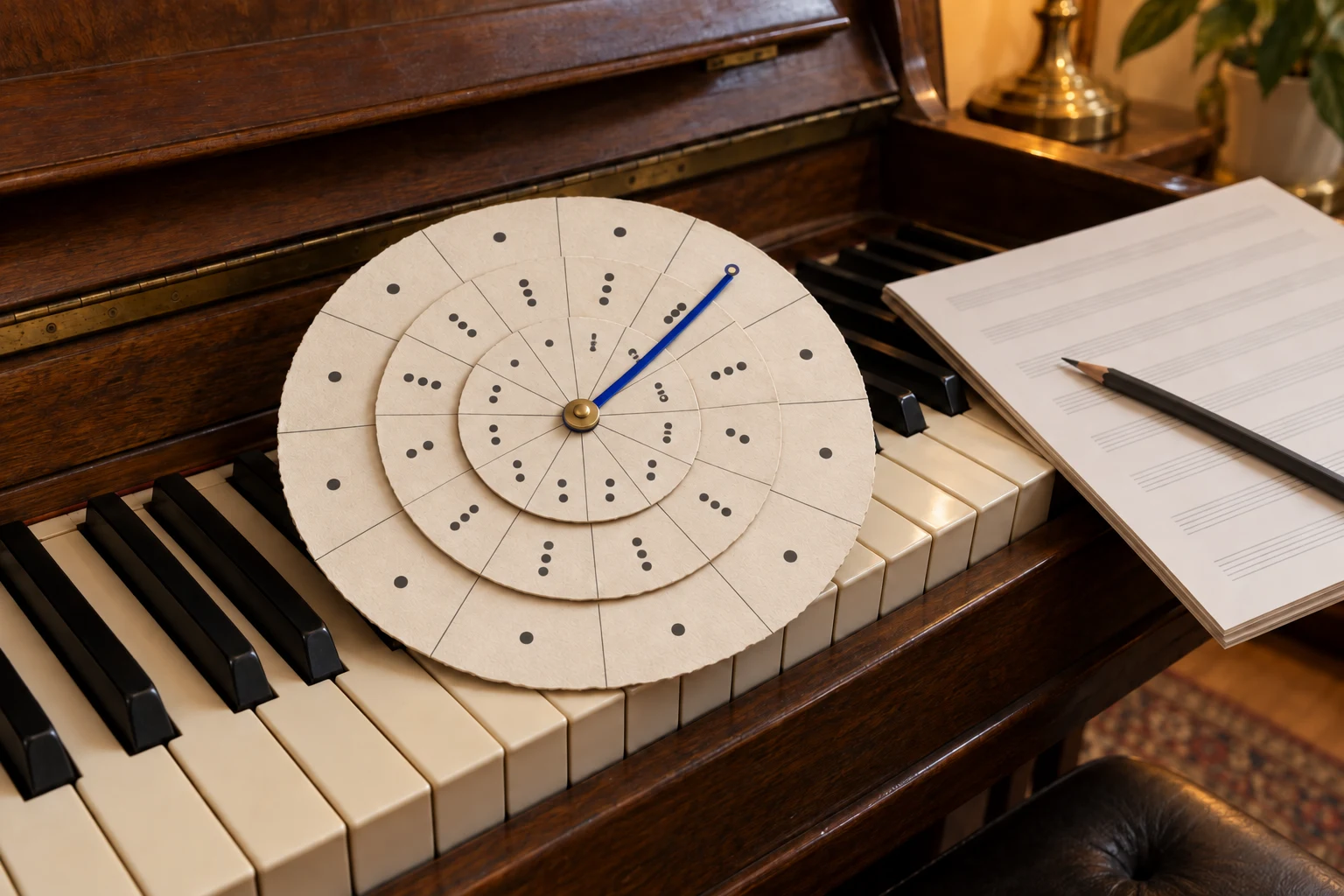
His fix is one sentence, and he stops the lesson to say that if you forget everything else, remember this: those twelve letters can mean notes, or chords, or keys, and the circle works differently in each reading. This guide takes those three readings in order, then hands you a generator for every theory skill underneath them.
Building the Wheel Takes About a Minute
Start at C, the note most theory orbits. Move a fifth, which is seven half steps, and you land on G. Another fifth gives D, then A, E, B, and F sharp, filling the clockwise half. Go back to C and travel the other direction for F, B flat, E flat, A flat, and D flat.
Mnemonics beat counting here, and the lesson's own are the mildly ridiculous kind music teachers trade, cleaned up when the class is young enough to need it. Any sentence works if the first letters run C G D A E B. Once the shape is in your head, the Circle of Fifths Practice Generator quizzes you on positions and relationships until reading the wheel is faster than reciting it.
Reading One: The Letters Are Notes, and Chords Get Easy
Building a chord means finding notes that sit awkward distances apart, and the fifth is the awkward one. C major needs C, then E a major third up, then G. That G is a fifth above C, which means it's one tick clockwise on the wheel, no counting required.
The payoff scales with difficulty. For an A flat major seventh, you need A flat, then C, then E flat, then G. Finding E flat by counting half steps is slow, and the lesson's point is that it's one tick clockwise instead. Harmonizing a melody a fifth above works the same way, which is why vocal arrangers keep the wheel in view.
Two generators cover this ground. The Chord Identification Practice Generator drills naming and spelling chords in every quality, and the Interval Identification Practice Generator trains the distances underneath, since a fifth you can hear beats a fifth you have to count.
Reading Two: The Letters Are Chords, and the Wheel Points at the Tension
Switch your reading and each letter becomes a chord. Now the circle answers the question every songwriter asks: which chord creates the pull back home?
Every key has two chords doing most of the work, the root and the dominant, and the dominant is the one that builds tension the root resolves. On the wheel it's always one tick clockwise from your root. In B flat, the dominant is F. In D, it's A. In D flat, it's A flat. No counting through the scale, and the relationship holds in all twelve keys.
- The Chord Progression and Inversion Practice Generator builds progressions to analyze and play, inversions included.
- Roman numerals are how progressions travel between keys, since a I-V-vi-IV works in all twelve. The Roman Numeral Harmony Analysis Practice Generator trains that notation on real progressions.
- Endings have grammar too, and the Cadence Identification Practice Generator sorts authentic from plagal from deceptive, which is what harmony exams ask you to hear.
Reading Three: The Letters Are Keys, and Distance Means Difficulty
The lesson calls this reading the most valuable, and it turns the wheel into a map with a distance scale.
Neighboring keys are nearly the same key. C major and G major share every note but one, F against F sharp. So a modulation from C to G is smooth, because your listener only has to accept a single new sound. Now look across the circle: C to F sharp shares almost nothing, and dropping that many new notes at once sounds abrupt. The professional fix is to walk the wheel, C to G, G to A, introducing one new note at a time until you arrive.
Position also tells you the key signature outright:
| Direction from C | Keys | What accumulates |
|---|---|---|
| Clockwise | G, D, A, E | One sharp, two, three, four, added in the order F#, C#, G#, D# |
| Counterclockwise | F, B♭, E♭, A♭ | One flat, two, three, four, added in the order B♭, E♭, A♭, D♭ |
Sharps begin at F and march clockwise. Flats begin at B flat and march counterclockwise, staying one tick ahead of the key you're reading. Drill the whole system with the Key Signature Practice Generator rather than re-deriving it under exam pressure.
The Scales the Wheel Is Made Of
Every position on the circle is a key, and every key is a scale. The Major Scale Practice Generator covers the whole-whole-half pattern that generates all twelve, and the Minor Scale and Modes Practice Generator handles natural, harmonic, and melodic minor plus the modes, including the relative minor sitting inside each major key on the wheel.
Reading the Page, Not Only the Theory
Theory without notation is a conversation you can't write down. The Clef and Note Reading Practice Generator drills treble, bass, and the C clefs that ambush string players. Rhythm needs its own reps, so the Rhythm and Note Value Practice Generator covers note values, rests, and the time signatures that organize them. When vocabulary is the blocker, the Music Theory Terminology Glossary Generator defines terms at the level you're working.
Teachers get two more. The Music Theory Practice Worksheet Generator produces fresh worksheet sets on any topic here, and the Music Theory Lesson Plan Generator structures the sequence for a class or a private student.
| Option | What you get | Best for | Skip if |
|---|---|---|---|
| A circle of fifths poster | The diagram, permanently, on your wall | Glancing at it mid-practice | Looking at a chart is not the same as using it, which is the whole problem above |
| An interactive circle website | Click a key, see its chords | Quick lookups while writing | It answers for you, so the relationships never move into your memory |
| The generators above | Problems on the reading you name, notes, chords, or keys | Turning the diagram into recall you can use while playing | You haven't built the wheel yet, spend the first minute above |
Keep a theory notebook in a Dock Editor document: one page per key, its signature, its dominant, and the two neighbors you could modulate to. Twelve short pages and the wheel stops being a poster. The first week there costs nothing.
Try the three readings tonight on one key you already play. Name its notes, name its dominant chord, then name the two keys next door and what single note separates them. Whichever of the three you stumble on is the reading to drill this week. Every music generator lives in the education prompt library.