"What should I draw tonight" has a whole internet genre devoted to answering it, and the listicles that dominate that genre share a flaw: a hundred random suggestions, none of them yours, none of them aimed at anything. The artists who improve treat ideas differently. Each drawing is pointed at a weakness, a hand, a pose, a face at three-quarter view, so the page fills AND the skill moves.
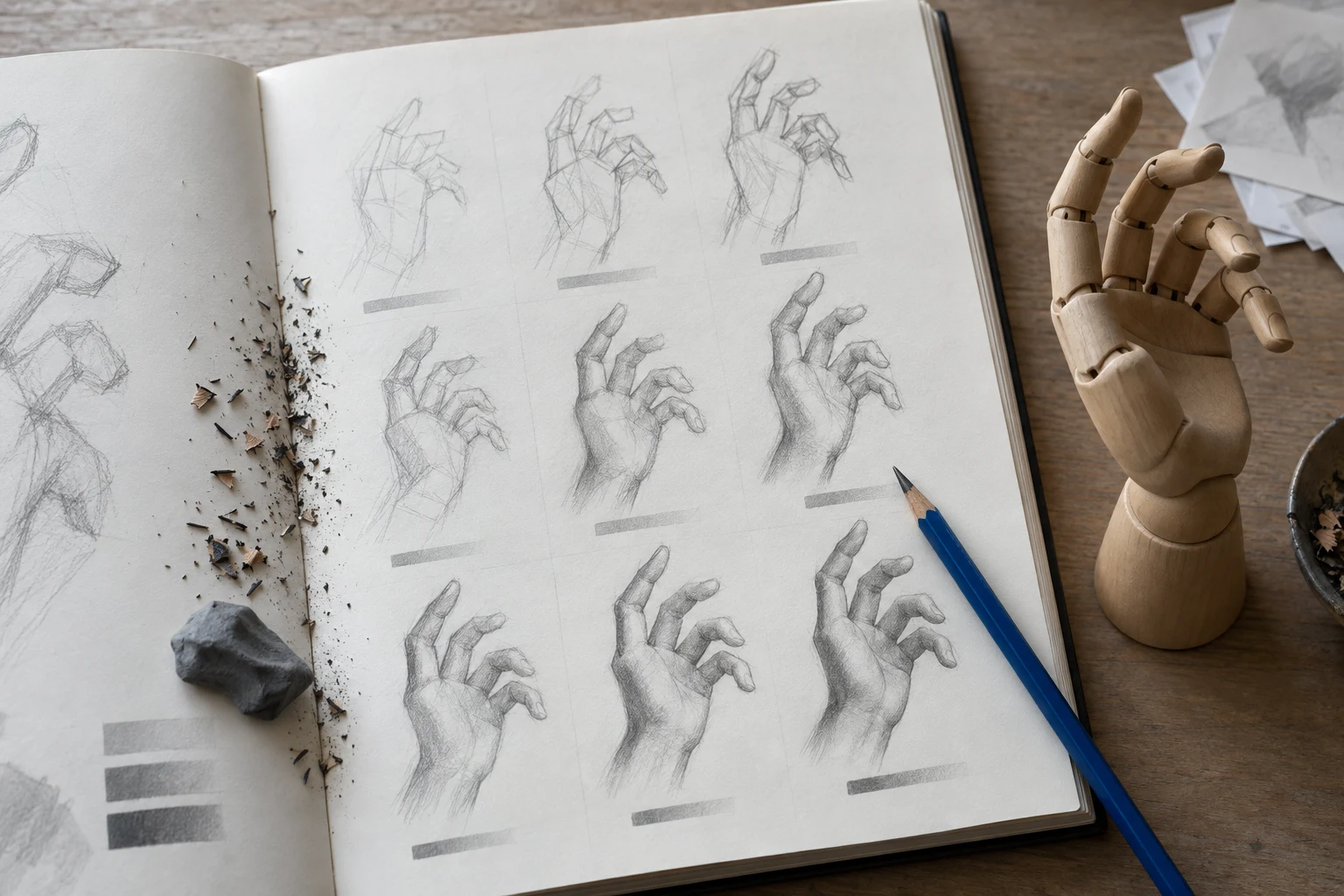
This guide covers both halves: generators that hand you drawing ideas on demand, and the anatomy, gesture and theory tools that turn those ideas into deliberate drawing practice.
Ideas on Demand, Aimed at Your Level
- The Daily Drawing Challenge Generator produces drawing prompts scaled to your skill and interests, a month of subjects in one run, which retires the what-should-I-draw question for good.
- The Figure Pose Description Generator describes poses in precise anatomical language for figure drawing sessions when no model or photo reference is at hand.
- The Comic Storyboard Panel Description Generator hands sequential artists panel-by-panel scenes to stage, which is drawing ideas with a story attached.
The Sketchbook Method: Where Ideas Become Practice
A practice-method video with over five million views argues for a $15 tool over any tablet: a sketchbook, used as "a visual journal." The reasoning cuts at digital habits: art programs are "so forgiving" that you "can get caught in this loop of endless edits," while a paper page tolerates only so much erasing before it forces you to the next drawing. The learning, it argues, concentrates in "that sketching phase where you're analyzing, you're breaking down," not in the polish.
Two rules from that method travel well. Pages "don't need to be perfect, they're for you and for you only." And curiosity is a study plan: wonder what a rhino looks like in profile, look one up, sketch it, and you "leave an imprint of that in your brain" that's still there the next time a rhino is asked of you. Thirty minutes, a pencil, a subject on your screen.
Anatomy: The Drawing Ideas That Compound
Anatomy for artists is where random practice becomes deliberate, because the body is the subject every figure, portrait and character drawing secretly depends on.
- The Figure Anatomy Study Plan Generator sequences the whole study, which muscle groups in which order, so anatomy stops being an intimidating pile.
- The Torso and Limb and Skull and Skeletal Anatomy Drawing Guides break the big structures into drawable landmarks.
- The Hands and Feet Anatomy Guide targets the parts artists famously hide in pockets, and the Facial Features and Portrait Proportions Generator lays down the how-to-draw-a-face measurements that make likenesses stop drifting.
- The Eye Drawing Practice Generator drills the single feature beginners fixate on first.
Gesture, Perspective, Caricature: The Skills Between Ideas
Gesture drawing is the anatomy antidote, thirty-second poses that capture energy before accuracy, and the Gesture Drawing Practice Generator runs those timed sessions with pose after pose. The Perspective Drawing Exercise Generator builds the one-point-through-three-point ladder that makes environments stop leaning. And the Caricature Drawing Practice Generator teaches exaggeration as a skill, which sharpens likeness even for artists who never draw funny.
Color, Style and What Art Means
- The Color Theory and Elements of Art Explainer covers the wheel, harmony and value at whatever depth your work needs, the study half of a topic usually taught by expensive trial and error. Musicians work from a wheel of their own, and the circle of fifths guide shows how it maps harmony the same way.
- The Digital Painting and Shading Technique Guide maps shading techniques from hatching to rendering, for the moment the sketchbook work moves back to the tablet.
- The Art Movement Explainer and Study Guide decodes the art styles question from Impressionism forward, and the Cultural Art Symbolism Explainer unpacks what the images meant to the people who made them, which is art history serving your own work.
- For pure fun between studies, the Hieroglyphic Name Translator renders names in Egyptian script, a ready-made sketchbook page. Drawing a fantasy map or character? The fantasy name generators guide names the places and people on it.
| Source of ideas | What you get | Best for | Skip if |
|---|---|---|---|
| A listicle of 100 prompts | Random subjects | Breaking a blank-page freeze once | Every idea is a stranger's, nothing targets your gaps |
| Reference sites and photo packs | Real things to observe | The observation half of any study | You still need to choose WHAT to study |
| The generators above | Subjects aimed at your named weak spots | Deliberate daily practice | You're mid-flow on a piece, finish it first |
An art-study log wants one home, and a Dock Editor document per month holds the challenge list, the study notes and the what-I-learned lines beside each other. It costs nothing for your first seven days.
Name your weakest subject out loud, hands, horses, three-quarter faces, then let the matching generator above hand you tonight's page. One aimed drawing a day outbuilds a hundred random ones, and the sketchbook doesn't care how the first ten look. The rest of the study tools live in the education prompt library.