Transition words show the reader how two ideas connect. Addition, contrast, cause, sequence. Pick the wrong one and the logic breaks, even when every sentence is correct on its own.
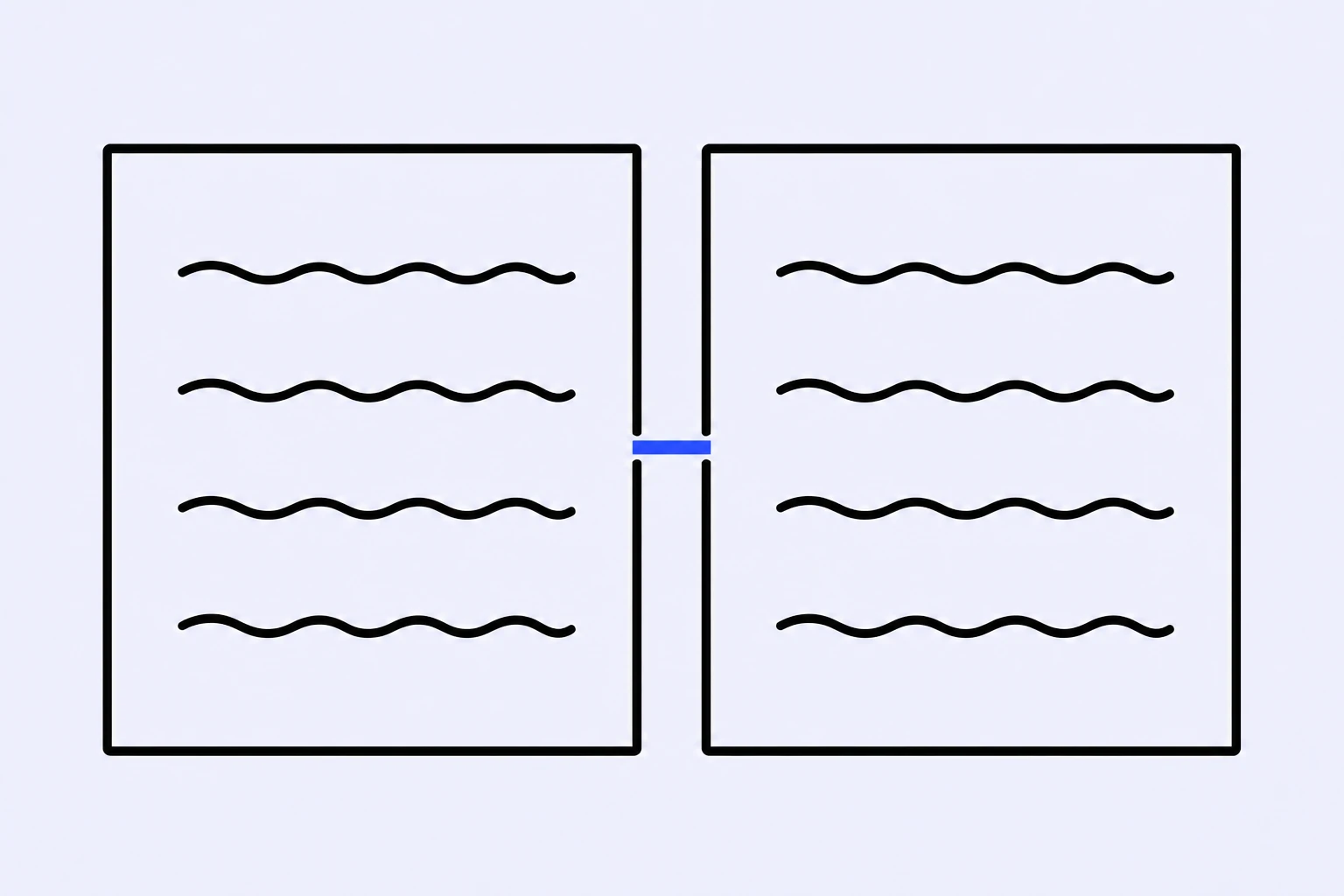
Most lists dump 200 transitions in a wall and leave you to guess. That's useless mid-essay. What you need is the right word for the relationship you're showing, so this is sorted by the job each one does, with the traps flagged.
Here's the rule underneath all of it: a transition names the logical relationship between what you just said and what comes next. If you can't name that relationship, you don't need a transition. You need a better sentence.
When You're Adding a Point
Use these when the next idea supports or extends the last one.
also, in addition, furthermore, moreover, likewise, similarly, what's more, on top of that
Trap: "Furthermore" and "moreover" pile up fast and start to sound like a debate-club robot. One per paragraph, maximum. "Also" is usually the better word, and you can often just start the new sentence with no transition at all.
When You're Showing Contrast
Use these when the next idea pushes against the last one.
however, on the other hand, in contrast, yet, still, although, whereas, even so, that said
Trap: "However" belongs after the contrast, not always at the front. "The data looked strong. The sample, however, was 12 people." That placement reads sharper than opening every contrast with "However,".
When You're Showing Cause and Effect
Use these when one thing produces another.
because, therefore, as a result, consequently, thus, since, so, for this reason
Trap: "Thus" and "consequently" sound formal, which students reach for to sound smart. In most essays "so" or "as a result" reads cleaner and does the same work.
When You're Showing Sequence or Time
Use these to order steps or events.
first, next, then, after, before, meanwhile, finally, once, during
Trap: "Firstly, secondly, thirdly" is stiff. "First, second, third" is fine, and often the paragraph order makes the sequence clear without any of them.
When You're Giving an Example
Use these to move from a claim to proof.
for example, for instance, specifically, in particular, to illustrate, namely
When You're Emphasizing a Point
Use these when the next idea is the important one.
in fact, indeed, above all, most important, notably
Trap: If everything is emphasized, nothing is. Use these once or twice per essay, on the point that carries the argument.
When You're Concluding
Use these to signal the end, in the conclusion only.
in conclusion, to sum up, overall, in short, ultimately
Trap: "In conclusion" is the most overused essay phrase there's. A strong conclusion rarely needs it. Start the final paragraph with your point, not with a label announcing that it's the final paragraph.
Where Transitions Go
Transitions do two jobs, and they live in two places.
Between sentences, inside a paragraph, to connect one idea to the next. This is where most of your transitions belong.
Between paragraphs, as the first sentence of the new paragraph, to connect the whole paragraph back to the last one. This is the harder one, and it's where essays feel choppy when it's missing. The paragraph structure explainer shows where the paragraph-level transition sits, and the transition words helper suggests the right connector for a relationship you describe.
Transitions Fail When Every Sentence Has One
More transitions don't make writing smoother. Past a point they make it worse, a train of "Furthermore, moreover, in addition, additionally" that reads like padding. The fix is usually to cut, not add. If two sentences already connect clearly, the transition is dead weight.
AI is decent at spotting a missing transition and terrible at knowing when you have too many, since it defaults to adding connectors. If you draft in AgentDock Editor, you can read the paragraph back and cut the transitions that are propping up sentences that should connect on their own.
FAQ
What are transition words in an essay? Words that show how two ideas connect, like "however" for contrast or "because" for cause. They guide the reader through your logic.
What's a good transition word to start a paragraph? Depends on the relationship. For a contrasting paragraph, "still" or "yet." For one that builds on the last, "beyond that." Avoid opening every paragraph with "Additionally" or "Furthermore."
Can I start a sentence with "however"? Yes, though placing it after the contrast often reads better. "The plan was solid. The budget, however, was not." Both are correct.
How many transition words should an essay have? No fixed number. Enough that the logic is clear, few enough that they don't read as padding. If a paragraph has a transition in every sentence, cut half.
Is "in conclusion" a good transition? It works, but it's overused. A strong final paragraph usually opens with its point instead of announcing itself with "in conclusion."