Every preschool skill lives in one of two muscle groups, the big ones or the small ones. Gross motor skills are the big half, running, jumping, balancing, climbing, the arms-legs-and-trunk movements that carry a child through a playground. Fine motor skills are the small half, fingers and hands doing buttons, scissors, and pencil grips. A preschooler is building both at once, and the activities that build them don't require anything you'd have to buy.
This guide covers what each skill set is, the therapist-grade activities that develop them, and the planning tools that turn a week of preschool into a week of development.
Gross Motor or Fine Motor? The Split That Organizes Everything
| Skill set | The muscles | What it looks like at 3 to 5 | The generator |
|---|---|---|---|
| Gross motor skills | Arms, legs, core | Running, hopping, balancing, throwing, stairs | Gross Motor Activity Generator |
| Fine motor skills | Fingers, hands, wrists | Scissors, beads, buttons, drawing, playdough | Preschool Fine Motor Activity Generator |
The two halves feed each other. A child who can't sit stable at the core will struggle to control a pencil at the fingers, which is why occupational therapists check posture before handwriting. Build your week big first, small second, both daily.
A Physical Therapist's Home Playbook, No Equipment Required
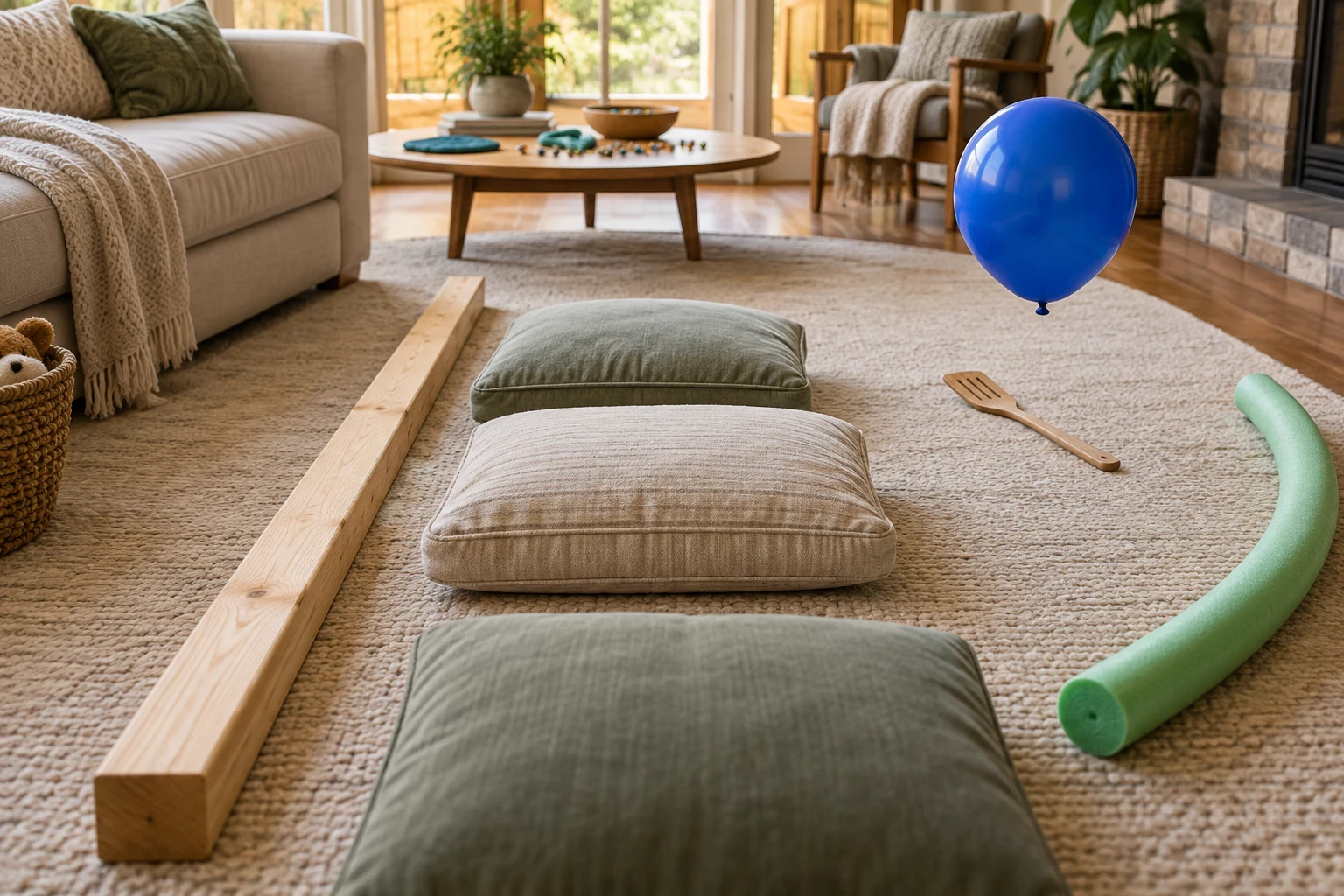
A pediatric physical therapist's demonstration from Michigan Medicine builds a full motor session from household junk, and her framing is the one worth stealing: balance is the skill physical therapy works on most, and "it doesn't take expensive toys or equipment" to train it.
- A two-by-four on the floor is a balance beam. Out in the world, curbs and sidewalk cracks do the same job. When walking it gets easy, have your child pick up objects mid-walk without stepping off.
- Dynamic balance means standing steady on a wobbly surface. A couch cushion works, a pool noodle is the advanced course, and she runs it during TV commercials so it costs zero schedule time.
- Balloon tennis with a spatula racquet trains hand-eye coordination, which pays off later in an unexpected place, copying words down from the board.
- Playdough is finger strengthening disguised as art. Roll a snake with straight fingers, smash the stack into a pancake, then hide beads inside for tiny fingers to excavate. The Preschool Playdough Activity Generator produces a new session of exactly this kind on demand.
For the movement half of the day, the Preschool Movement Song Generator writes songs with jumping, stomping, and freezing built in, gross motor activities that a three-year-old experiences as a party. One boundary the therapist draws clearly and this guide repeats: if you're concerned about your child's development, that conversation belongs with your pediatrician, not a generator.
Play-Based Learning Is the Delivery System
Play based learning is the reigning pedagogy in early childhood because at this age, play is how skills get in. The academic content hides inside the fun, and these generators build the disguise.
- Sensory play carries fine motor practice inside the mess. The Sensory Bin Idea Generator designs bins around whatever filler you have, rice, beans, water beads, with the scooping and pinching doing the developmental work.
- The Preschool Art and Craft Activity Generator plans crafts where cutting and gluing are the hidden curriculum.
- Early math arrives through games, and the Preschool Counting Game Generator keeps numbers physical and touchable, with the Preschool Math Activity Generator widening past counting into the rest of early math.
- Curiosity gets its own slot. The Preschool Science Experiment Generator designs safe kitchen-table experiments where the pouring is secretly motor work too.
Language Skills Ride the Same Play Train
The literacy half of preschool learning activities follows the identical hide-it-in-play rule. The Preschool Rhyming Activity Generator builds the ear for word endings. Its sibling, the Preschool Phonemic Awareness Activity Generator, isolates the individual sounds that reading later stands on. The Letter of the Week Activity Generator structures the alphabet march for your classroom (the alphabet, phonics and sight-word decks in our flashcard maker rundown cover the kitchen-table version), and story time earns its slot twice over with the Preschool Story Time Discussion Generator and a stocked shelf from the Preschool Book Recommendation List Generator.
Building the Week Around the Skills
A week of skills doesn't happen on its own, it needs a schedule to live in.
- The Preschool Weekly Activity Plan Generator maps the week so gross motor, fine motor, and literacy each get daily slots.
- Circle time anchors your morning, and the Circle Time Plan Generator scripts it with songs, calendar, and movement breaks.
- The moments between activities are where preschool falls apart, so the Preschool Transition Activity Generator turns cleanup and line-up into games instead of chaos. Classroom teachers will find lesson plans, worksheets and management routines in our preschool and kindergarten setup kit.
- At home, the Toddler Daily Routine Generator brings that structure home for the younger siblings (homeschooling families will find clock-free daily rhythms in our homeschool schedule guide), and the Potty Training Chart Generator takes on the developmental milestone nobody puts on a curriculum but everybody schedules around.
Watching the Development, Not Only the Fun
Activities without observation aren't teaching, they're entertainment. Two tools close the loop: the Preschool Developmental Assessment Generator structures what to look for in each domain, and the Preschool Daily Report Generator turns the day into a parent-ready note. When the kindergarten question approaches, the Kindergarten Readiness Checklist Generator maps where a child stands across every skill this article covers.
Observation notes deserve a better home than sticky notes. A Dock Editor document per child, dated entries, one line per breakthrough, builds the record your parent conferences are made of, and the trial week costs nothing.
| Option | What you get | Best for | Skip if |
|---|---|---|---|
| An OT or PT evaluation | Professional assessment and a therapy plan | Real developmental concerns, flagged early | It's the pediatrician's referral to make, start there |
| Pinterest activity boards | Endless photogenic ideas | Occasional inspiration | Pretty is the filter there, developmental value is an accident |
| The generators above | Activities built around a named skill | Deliberate skill-by-skill planning, fresh every week | You need a diagnosis, not an activity, see row one |
Pick the skill your kid or class wobbles on most, balance, scissors, or sounds, and run one targeted activity tomorrow morning. A two-by-four and ten minutes outbuild a cart full of equipment. The whole early-childhood lane lives with the rest of the education prompt library.