Homeschooling is legal in all 50 states, and every state writes its own rules. There's no federal homeschool law. Regulation belongs to the states, so the question is never whether you can homeschool, it's what your particular state wants filed, logged, and reviewed. The good news hiding in that mess is that nearly everything on any state's list is a document, and documents can be drafted in an afternoon.
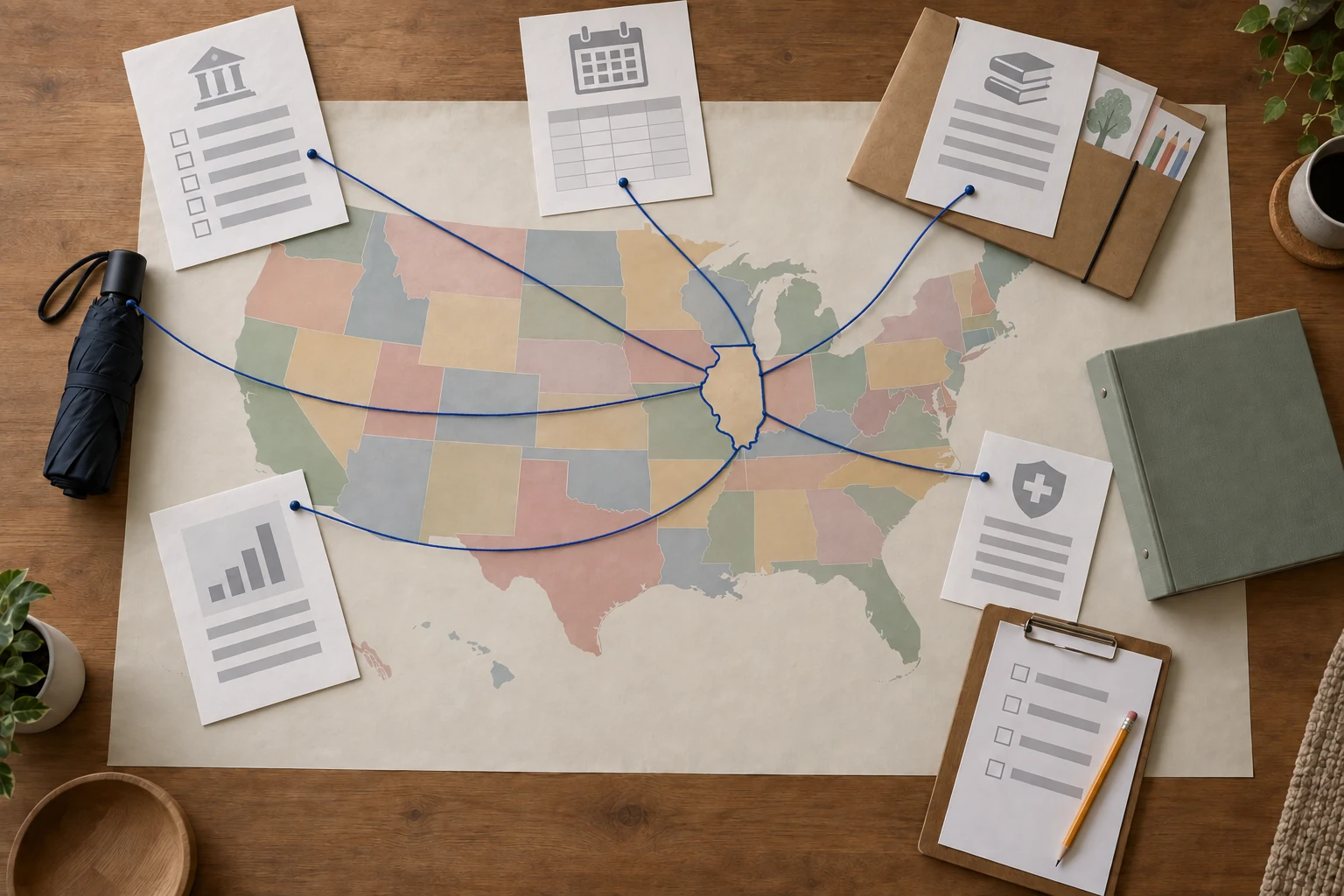
This guide covers where the real rules live, the five requirement types states draw from, and a generator for each piece of paperwork on the list.
Read the Homeschool Version of the Law, Not the Public School Version
State education websites are the worst place to start. A five-part school-to-homeschool crash course taught by a former public-school teacher describes hunting one state's rules and landing on the raw 60-page bill instead of a summary. Her shortcut is the one everyone in the community uses: HSLDA, the Home School Legal Defense Association, keeps a condensed state-by-state breakdown written by attorneys from every state.
Two of her rules earn a place on your wall. First, homeschool law isn't public school law: her home state of Colorado asks homeschoolers for 172 days at an average of 4 hours, a 688-hour minimum, and a subject list that fits in a paragraph, while the public-school standards run to pages. Second, when you do file, "you want to submit only the bare minimum" the statute names. Over-sharing invites questions the law never required you to answer.
The Homeschool State Requirements Checklist Generator turns your state's rules into a personal to-do list with deadlines, so the research you did on HSLDA becomes a checklist with dates on it.
The Five Requirements States Draw From
Almost every state builds its homeschool requirements from the same five parts. Which ones apply, and how strictly, is the whole difference between a strict state and a relaxed one.
| Requirement | What it means | The tool that drafts it |
|---|---|---|
| Notice of intent | A letter telling the district or state you're homeschooling | Notice of Intent Letter Generator |
| Standardized testing | Periodic tests, often with alternate proof paths | Your state lists approved tests, no letter needed |
| Portfolio review | A year's work samples reviewed by an evaluator | Work Sample Log Generator |
| Umbrella or cover school | Enrolling under a registered school entity | Umbrella School Enrollment Packet Generator |
| Instructional plan | What you'll teach and with what curriculum | Curriculum Scope and Sequence Generator |
The Letters That Start a Legal Homeschool
Pulling a child out mid-year starts with a different letter than starting fresh in the fall, and mixing them up is the classic first mistake.
- Leaving an enrolled school? The School Withdrawal Letter Generator drafts the formal notice that ends the enrollment cleanly, which matters because an un-withdrawn child is a truancy case waiting for a clerk to notice.
- The notice of intent to homeschool comes next, or first if your child was never enrolled. States differ on the deadline, the recipient, and whether it repeats annually, and the Notice of Intent Letter Generator matches the letter to your state's format.
- In umbrella-school states, enrollment paperwork replaces some direct filings. The Umbrella School Enrollment Packet Generator assembles the packet, and where the arrangement runs through a cover school, the Cover School Affidavit Generator produces the affidavit that formalizes it.
- Charter and ISP arrangements want a learning plan up front, and the Charter ISP Learning Plan Generator writes one that satisfies the reviewer without over-promising your year.
The Proof States Ask For as the Year Runs
Filing the letters makes you legal on day one. Staying legal is an evidence habit, and the evidence requirements are where the day-count and hour-count laws bite.
Log days and hours as you go with the Homeschool Attendance Log Generator, because a 688-hour minimum is easy to prove in October and impossible to reconstruct in May. How to lay out the days that fill those hours is in our homeschool schedule guide. High schoolers in hour-counting states get the same math from the Credit Hour Calculator. For portfolio-review states, the Work Sample Log Generator keeps the evaluator's stack growing all year instead of materializing in a panic the week before review.
When the annual reckoning arrives, two generators close the loop: the Annual Evaluation Letter Generator for states that want an evaluator's sign-off, and the Yearly Summary Report Generator for states that accept a written summary of the year's progress.
Keep the whole compliance trail in one place. A single Dock Editor document per school year holds every letter you sent, the date it went, who confirmed receipt, and the running attendance totals, and trying it costs nothing for a week.
What Happens After the Withdrawal Letter Lands?
The paperwork takes an afternoon. The adjustment takes longer, and the community's standard advice is a transition period called deschooling before formal curriculum begins. The Deschooling Transition Plan Generator structures those first weeks so they're a reset rather than a void. When you're ready for community, our homeschool co-ops guide covers how to vet one.
Records grow into credentials eventually: transcripts, report cards, and the diploma question all have their own guide at homeschool diploma. Students who want an outside equivalency credential as well will find the exam side in our GED guide.
| Resource | What you get | Best for | Skip if |
|---|---|---|---|
| HSLDA state pages | Attorney-written summaries of homeschool laws by state | Knowing your actual legal list | You need the documents themselves, they describe rather than draft |
| State homeschool Facebook groups | Parents already running your state's rules | District-specific quirks no site covers | Treating anecdotes as law, verify against the statute |
| The generators above | The letters, logs, and packets, drafted | Producing every filing on your checklist | Your state's rule is ambiguous, and ambiguity is an attorney question |
One honest boundary: generators draft paperwork fast and well, but HSLDA and your state's current statute decide what belongs on your list. Verify the list first, then produce it. Tonight's version of that is simple: look up your state, write down what it asks for, and let the Homeschool State Requirements Checklist Generator turn it into deadlines. Every tool in this lane sits with the rest of the homeschool prompts.