Two identical bulbs, one battery, and the wiring decides whether both stay lit when one burns out. That's the whole distinction, and the physics behind it is a neat inversion: everything shared in a series circuit gets divided in a parallel one, and everything divided gets shared. Learn the pair as mirror images and you stop memorizing two unrelated rule sets.
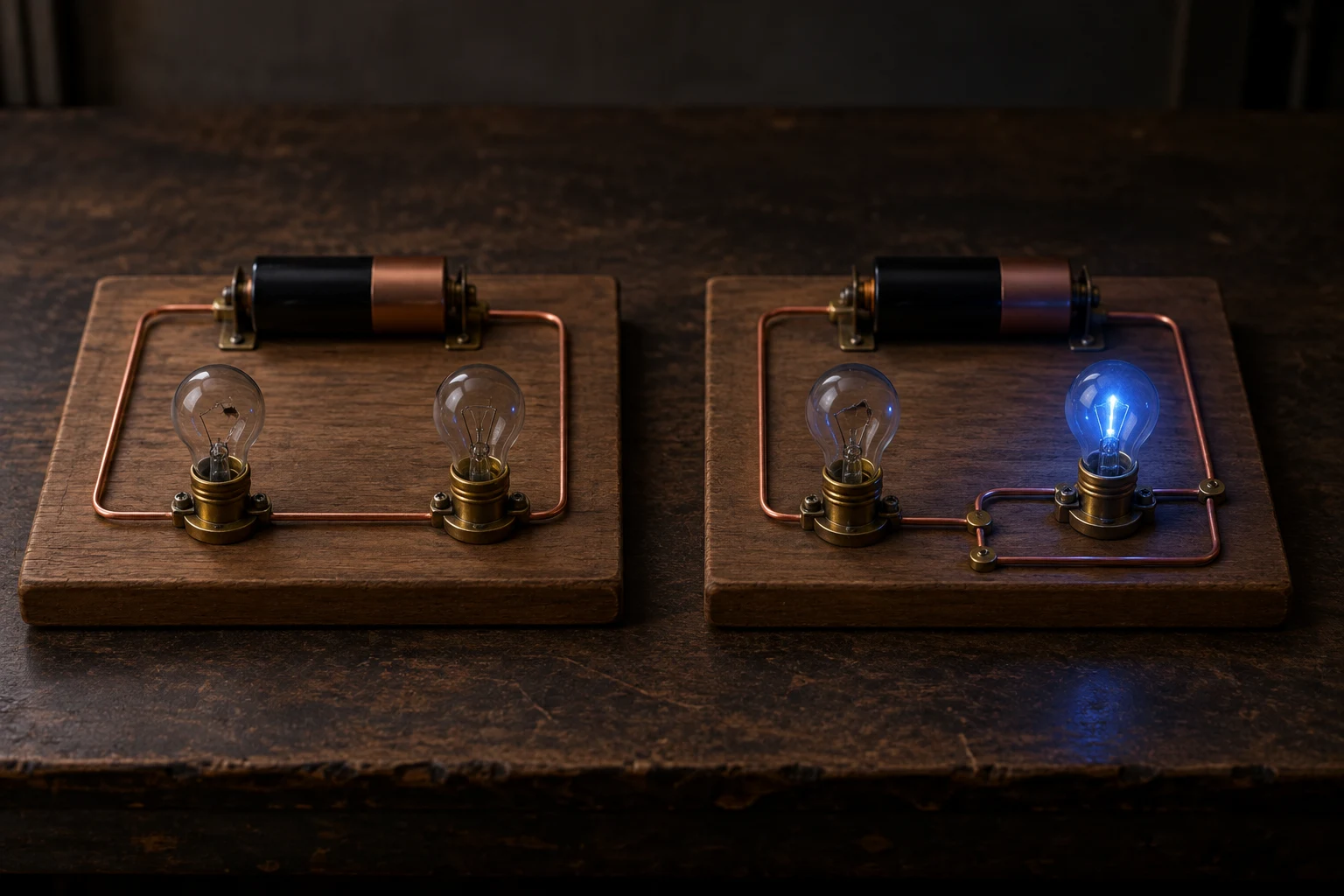
This guide covers both circuit types, the electrical quantities underneath them, and a solver for every calculation from voltage dividers to Faraday's law.
Voltage, Current, Resistance: The Three You Can't Skip
A circuits lesson puts these in plumbing terms that survive contact with harder problems. Voltage is "the electrical push that the battery gives to the electrons," measured in joules per coulomb. Current is the flow itself, "like water flowing in a pipe," measured in coulombs per second. Resistance opposes that flow, and in the same picture it's "as if the pipe carrying the current narrows."
Ohm's law binds the three: voltage equals current times resistance. Rearrange it and you can find any one from the other two, which is why ohms law practice problems are the drill nearly every course opens with. Work them through the Ohm's Law Solver, then add power with the Electrical Power Formula Solver, since P equals VI is the formula that turns circuit theory into an electricity bill.
Everything Shared in One Gets Split in the Other
Components in series sit end to end, one loop for the current to run around. Components in parallel sit side by side, so the current divides between branches. Every rule follows from that difference.
| Quantity | In series | In parallel |
|---|---|---|
| Current | Same through every component | Splits between branches, and the branch currents sum to the total |
| Voltage | Shared out among components | The same across every branch |
| Resistance | Add them up | Total drops below the smallest single resistor |
That bottom-right cell surprises students every year, so run the numbers from the lesson. Two 3-ohm resistors in series total 6 ohms, exactly as expected. The same two in parallel give 1/R = 2/3, so R equals 1.5 ohms, lower than either one alone. Try a 10 and a 5: 1/R = 1/10 + 1/5 = 3/10, and R lands at 3.33 ohms. Adding a parallel path always makes it easier for current to flow, which is why the total falls.
The Series and Parallel Circuit Solver works these combinations step by step, including the combination circuits where a parallel cluster sits inside a larger series loop and you have to reduce it in stages.
Two practical rules ride along with the table: a voltmeter connects in parallel with the component it measures, and an ammeter connects in series so the current runs through it. Wiring them the other way is a classic lab mistake.
When One Loop Isn't Enough
Real circuits branch more than a textbook pair of bulbs, and reducing them by inspection stops working. That's where the systematic tools take over.
- Kirchhoff's rules handle any network: current in equals current out at a junction, and voltages around a loop sum to zero. The Kirchhoff's Law Practice Generator drills both on circuits you'd struggle to simplify.
- Voltage divides across series resistors in a predictable ratio, which is the basis of half the sensor circuits ever built. The Voltage Divider Formula Solver computes it.
- Long wire runs lose voltage on the way, a practical problem for anyone wiring anything. The Voltage Drop Calculator Practice Generator covers those cases.
Capacitors: The Component That Stores Instead of Resists
A capacitor holds charge rather than opposing current, and it inverts the resistor rules in a way that catches people out. The Capacitor Charge Formula Solver handles the charge, voltage, and capacitance relationship, while the Capacitor Series and Parallel Solver covers combinations, where the arithmetic behaves opposite to resistors.
Put a capacitor with a resistor and you get time in the circuit. Charging follows an exponential curve set by the product of the two, the time constant behind every blinking light and camera flash, which the RC Circuit Time Constant Solver calculates. The curve itself is exponent algebra, so our exponent rules guide is the fix when the time-constant math stalls.
The Fields Underneath the Wires
Circuits are the applied layer. Underneath sit the fields that make charge move at all.
Charges attract and repel by an inverse-square law, worked by the Coulomb's Law Solver, and the space around a charge is described by the Electric Field Strength Solver. Moving a charge through that field costs or releases energy, which the Electric Potential Energy Solver quantifies, and potential energy per charge is voltage, which closes the loop back to the top of this article.
Magnetism Is the Same Story in Motion
Moving charges make magnetic fields, and magnetic fields push moving charges. That two-way relationship is the whole subject.
- The Magnetic Force Solver handles the force on a charge or a current-carrying wire, including the right-hand rule that decides direction.
- Current in a wire creates a field around it, computed by the Magnetic Field of a Current-Carrying Wire Solver.
- Reverse the causation and a changing magnetic field induces a current, which is how every generator on the grid works. The Faraday's Law of Induction Solver covers it.
- Four equations tie all of it together and predict light itself. The Maxwell's Equations Explainer walks them at whatever depth you need, and the Electromagnetic Spectrum Explainer shows what those waves become across frequencies.
Forces of the mechanical kind, the ones that came before this unit, live in our friction guide. Waves, light, heat and modern physics, the rest of the second semester, are in our Doppler effect to half-life guide.
| Option | What you get | Best for | Skip if |
|---|---|---|---|
| A circuit simulator | A working virtual breadboard | Seeing behavior change as you tweak values | Watching a simulation isn't solving, and the exam is paper |
| Online resistance calculators | The combined value, instantly | Checking a number mid-homework | The reduction steps are the graded part |
| The solvers above | Worked circuits with the reasoning shown | Learning to reduce networks yourself, fresh problems each time | You need a component for a real build, that's a parts catalog |
Track the formulas in a Dock Editor document as the unit runs, each one with the circuit diagram it applies to, because the hard part on exams is choosing the formula rather than computing it. Your first seven days there are free.
Test the mirror rule tonight on any two-resistor problem in your homework: predict from the table whether the total resistance rises or falls before calculating. If you can call it every time, the rest of circuit analysis is arithmetic. The full physics bench, mechanics and waves included, is in the education prompt library.