Newton's laws look false on Earth, and friction is the reason. A rolling ball stops. A pushed box quits moving the moment you quit pushing. The first law promises neither should happen, and the gap between promise and observation is a force your textbook spends two chapters on. Learn friction properly and the rest of force physics problems stop being mysterious.
This hub covers the three laws, the two frictions, and net force, with a solver or practice generator standing at every step of the setup.
Each Law Is Its Own Exam Question
Each of Newton's laws of motion generates its own problem type, so treat them as three skills you drill separately rather than one list you memorize.
| Law | What it says in plain terms | The drill |
|---|---|---|
| First | Motion doesn't change without a net force | Newton's First Law Practice Generator |
| Second | F = ma, the workhorse of every calculation | Newton's Second Law Solver |
| Third | Every force has an equal, opposite partner | Newton's Third Law Practice Generator |
The second law does the computational work, but exams love the other two precisely because students treat them as trivia. Third-law questions about which object pushes harder trip more students than any calculation does.
Static and Kinetic: The Two Frictions in Every Problem
The top-ranked friction lesson on YouTube draws the distinction that organizes this whole topic. Static friction "resists the initiation of motion," and it's clever, pushing back exactly as hard as you push, so nothing moves. It scales with your push until it hits a ceiling, and past that ceiling the object breaks free into motion, where kinetic friction takes over.
The ceiling has a formula. Maximum static friction equals the coefficient of friction times the normal force, where the coefficient is a unitless number tabulated for surface pairs like rubber on concrete or steel on ice. Two facts about it decide most friction problems:
- Kinetic friction "is always lesser than static friction," which is why a heavy box is harder to start moving than to keep moving. Exams test that asymmetry constantly.
- Friction is proportional to the normal force, not to surface area or speed. A heavier object presses harder, makes more microscopic contact, and resists more.
Feed any coefficient problem to the Coefficient of Friction Formula Solver and it works the setup with steps shown, which beats hunting a worked example that happens to match yours. And friction isn't the villain of the course: the same lesson points out that walking and tire traction only work because static friction holds. Air resistance rounds out the family as fluid friction, thicker fluids resisting more.
Net Force Is the Question Behind Every Question
Strip away the story and nearly every force problem asks one thing: what's the net force? Weight pulls down, the normal force pushes up, an applied force pushes sideways, friction opposes it. Add the vectors. If they cancel, nothing accelerates. If they don't, F = ma tells you what happens next. The cancel case, with torques added, is all of engineering statics, the opening course in our moment of inertia and engineering formula sheet guide.
- Vector addition is the math skill underneath, and the Vector Addition Practice Generator drills components and angles until they're routine.
- The Net Force Calculation Practice Generator builds full problems around that one question, with the forces varied each round.
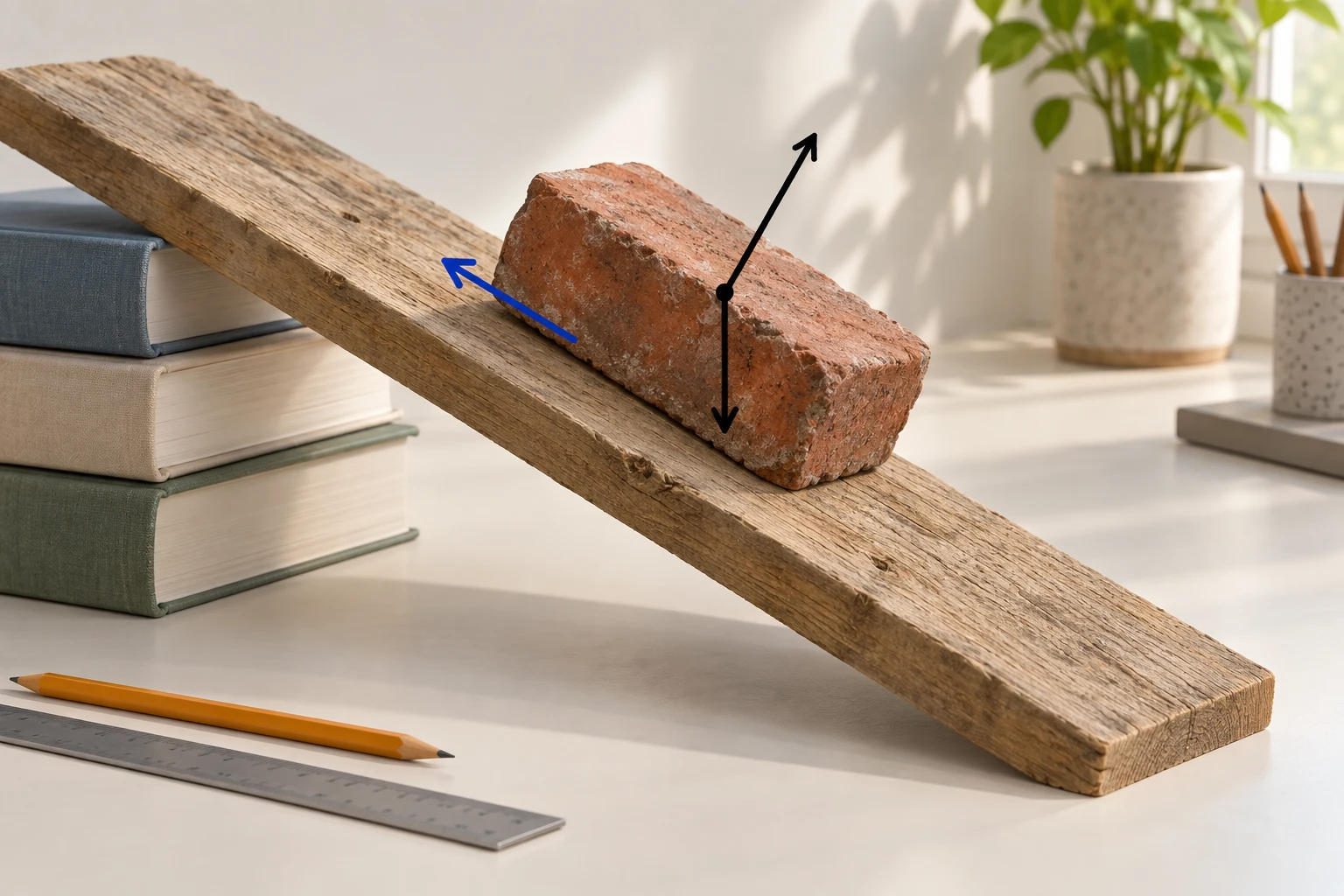
- The bookkeeping tool for all of it is the free body diagram, four arrows on a box, and the Free Body Diagram Practice Generator checks whether your arrows match the physics before your algebra inherits the mistake.
The Inclined Plane, Where Everything Combines
Ramp problems are the course's first boss fight because they demand every skill above at once. Gravity pulls straight down, but the ramp forces a coordinate change: the weight vector splits into mg cos theta pressing into the surface and mg sin theta pulling along it. The normal force cancels the first component. Friction fights the second. Whatever survives is the net force, and the block's acceleration follows. Ramps set at 30 or 45 degrees turn that split into special right triangles, so the sines and cosines come out exact.
Inclined plane physics rewards one habit, drawing the triangle before you touch the calculator. Practice the family with the Velocity and Acceleration Solver for the motion side, and when the problem launches something through the air instead, the Projectile Motion Practice Generator drills the same decomposition skill with horizontal and vertical components.
Once forces hand you an acceleration, the motion equations take over. That handoff, which equation applies and when, has its own complete guide at kinematic equations.
The Rest of the Force Family
Electric and magnetic forces wait for a later unit, covered in our series and parallel circuits guide. Five more forces show up once the basics hold, and each has its own solver:
- The Newton's Law of Gravitation Solver handles gravity between masses, the planetary version of the mg you've been using.
- Circular motion runs on the Centripetal Force Solver, the force question every curve and orbit hides.
- Springs follow Hooke's law, covered by the Hooke's Law Spring Constant Solver.
- Floating and sinking come down to the Buoyancy Force Formula Solver.
- When forces act over time, the Impulse-Momentum Theorem Solver connects the hit to the velocity change, and the Mechanical Advantage of Simple Machines Solver explains why levers and pulleys let small forces win.
| Option | What you get | Best for | Skip if |
|---|---|---|---|
| A physics solver app | The numeric answer, instantly | Checking your own finished work | It skips the setup, and the setup is the entire skill |
| Textbook problem sets | Curated difficulty curve | Assigned homework, obviously | You've run dry and the test wants fresh physics practice problems |
| The solvers and generators above | Unlimited problems with the setup shown | Learning the force-diagram habit on new problems every time | You haven't read the chapter once, do that first |
Keep a running formula sheet as you go: one Dock Editor document with each formula, its variables, and the first problem you met it in makes finals week a review instead of an excavation. The first seven days cost you nothing.
Tonight's assignment picks itself. Take any problem from this week's set, draw the four arrows before solving anything, and check the diagram against the generator's version. Wrong arrows explain more lost points than wrong algebra. The full physics lane, waves and circuits included, sits in the education prompt library.