The em dash is having the worst year of its five-century life. People now look it up to find out whether it makes their writing look like a machine wrote it: two of the four questions Google attaches to that search are "Does ChatGPT use em dash?" and "Why does AI use em dashes so much?" The mark has been in use since the 16th century, in Emily Dickinson and Kurt Vonnegut, and it hasn't done a thing wrong.
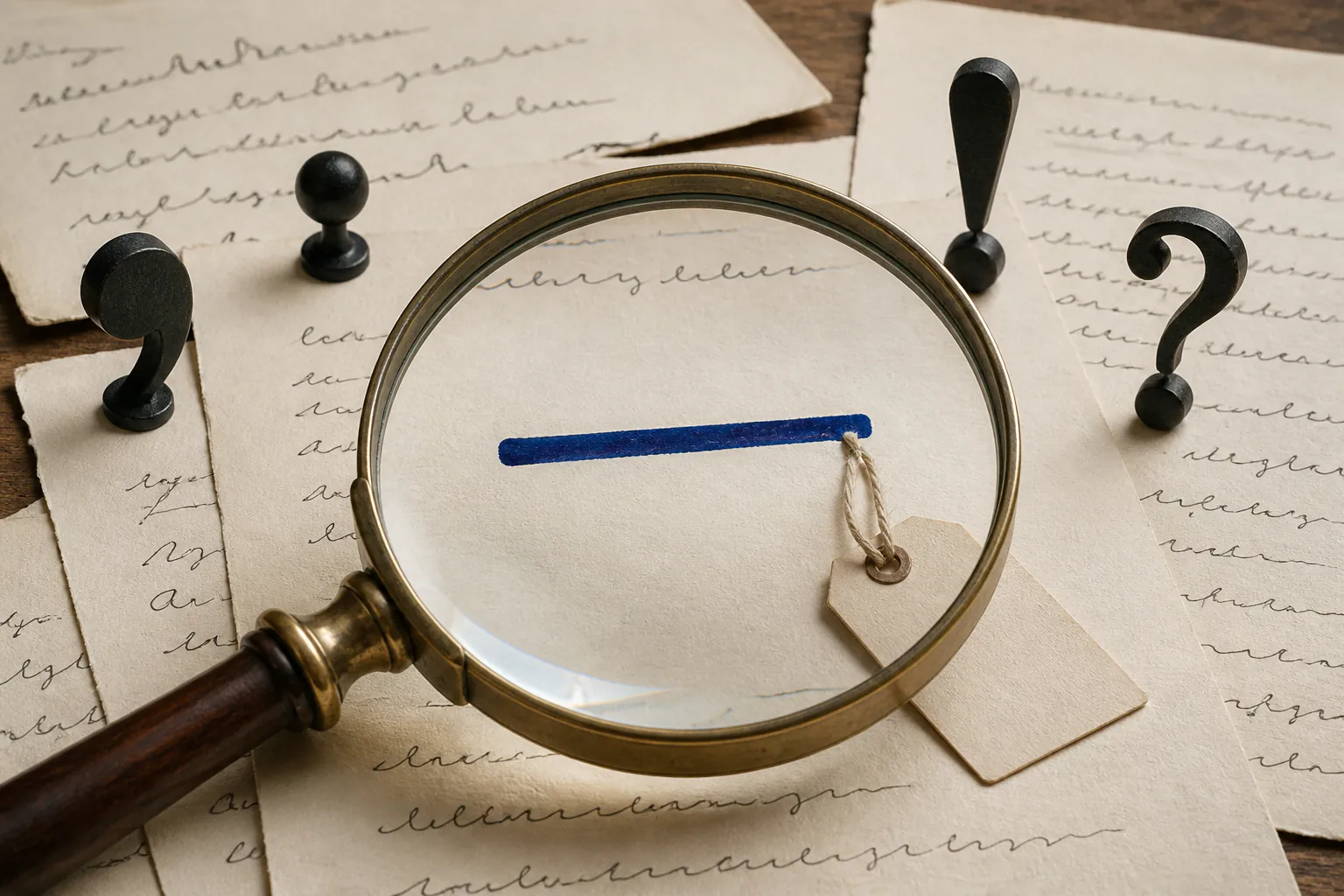
What changed is rate. Language models reach for it far more often than people do, so a page dense with them reads as machine-written even when a human typed every one, which means the thing giving you away was never the mark itself but how often it turns up.
That distinction matters because the popular fix doesn't work, and this article is about what does. Along the way it covers the marks you should be reaching for instead, which is the part your English teacher was right about all along.
Which Mark Does Which Job
Most overuse of one mark is really unfamiliarity with the other five. Each of these does something the others cannot:
| Mark | What it does | Best for | Skip if |
|---|---|---|---|
| Comma | Separates without stopping | Lists, and clauses that lean on each other | The two halves could each stand alone |
| Full stop | Ends the thought | Almost always. It's the default you're avoiding | The two ideas depend on each other |
| Semicolon | Joins two complete sentences | Two independent clauses too closely linked to split | Either half is a fragment |
| Colon | Announces what follows | Lists, definitions, and a payoff you have set up | Nothing is being introduced |
| Parentheses | Lowers a remark's volume | An aside the reader can skip | You want the reader to notice it |
Em dash (—) |
Breaks the sentence open, loudly | One genuine interruption, sparingly | You've already used one in this paragraph |
The em dash is the loudest option on that list, which is exactly why it can't be your default. A model reaches for it because it fits almost anywhere. A writer reaches for it because nothing else will do.
Removing the Dashes Doesn't Work
Evan Edinger's video on spotting AI writing has over two million views, and the most instructive part is a commenter who tried the popular fix. Matthew posted some flattering AI-written praise and cleaned it up first, replacing every dash with a hyphen.
Edinger pegged it in seconds anyway, then replied:
"you replaced that M dash with a hyphen, didn't you?"
He knew because the sentence still read it's not just about uploading in 4K, it's about making every shot count. The mirror construction was untouched, and that is the stronger tell. Matthew, to his credit, then posted the original ChatGPT prompt.
Six of the top twenty YouTube results for this topic are tutorials on removing em dashes from AI text. All six teach the move that failed here. Swapping one character while leaving the sentence architecture in place is the writing equivalent of changing the font.
The patterns that survive a find-and-replace:
- The mirror.
It's not just X, it's Y.Once is a rhetorical choice. Twice on a page is autocomplete. - Odd-number groupings. Threes and fives, over and over, whether or not the world came in threes.
- Safe vocabulary. Edinger names "elevate" and "delve," plus vague approval like "innovative" and "practical solutions." Words most people do not reach for in conversation.
- Text that says nothing. His phrase for the effect is "empty of meaning despite the words on the screen."
Edinger's own verdict is worth keeping, because it cuts against the panic: "ChatGPT bringing the M dash back into the mainstream isn't such a bad thing." He uses the mark in his video titles. It spaces a line out better than a full stop.
The cheaper fix is upstream anyway. Telling the model what shapes to avoid before it drafts beats editing them out afterwards, which is the practical half of prompt engineering.
Three Characters Get Called a Dash
Three characters answer to the name, and they do unrelated jobs.
- The Em Dash vs En Dash Explainer sorts all three with your own sentences as the examples. The short version: a hyphen joins words (
well-written), an en dash spans a range (Mon–Fri), an em dash breaks a sentence open. - Once you know which one you want, the Grammar Checker will flag where you've used the wrong one, usually a hyphen doing an en dash's job in a date range.
Almost nobody can type one, which is the other half of why it reads as a tell. Edinger's pop quiz asks which keys produce an em dash and assumes you don't know. On a Mac it's option shift minus. On Windows it's Alt and 0151 on the numeric keypad.
So when a character that needs a keyboard trick shows up eight times in one LinkedIn post, that's the arithmetic doing the work, not the punctuation.
The Oxford Comma Argument Has a Correct Answer
It depends on your style guide, with one exception that settles most arguments.
- The Oxford Comma Explainer is among the most-used grammar prompts we have. Feed it your own list and it shows you whether the comma changes the meaning, which is the only version of this argument that matters.
I thanked my parents, Ayn Rand and Godsays something different from the same list with a serial comma in it. - Comma splices are the more expensive error and nobody argues about them. Two complete sentences joined by a comma need a semicolon, a conjunction, or a full stop, and the Run-on Sentence Fixer is the most-used prompt in this whole set for a reason.
- The opposite failure, a clause posing as a sentence, goes to the Sentence Fragment Fixer.
Semicolons and Colons Are Not Interchangeable
Most people were taught the difference once and never used it again. It's a clean rule: a semicolon joins two things that could stand alone, a colon announces something.
- The Colon vs Semicolon Explainer runs both against your own sentence so you can see which one survives.
- The rule only helps if you can spot a complete clause, so the Independent Clause Identifier and the Dependent Clause Identifier come first. Semicolon rules are unusable without them.
- Still mixing up the terms? The Clause vs Phrase Explainer separates the two, and a phrase can never take a semicolon.
- The Sentence Types Identifier labels simple, compound, complex, and compound-complex in a passage you paste, which is the fastest way to see that your prose is all one shape.
Nobody Notices a Correct Apostrophe
Which is the whole problem with the unglamorous marks. They only ever get attention for being wrong.
- Possessives ending in
s, plural possessives, and theitsandit'scollision are the three that repeat forever. The Apostrophe Rules Checker works them on your own text rather than on a textbook example. - Does the comma go inside or outside the quotes? American and British conventions disagree, and the Quotation Marks Punctuation Explainer covers both plus nested quotes and dialogue.
- Headings are where consistency dies. The Title Case vs Sentence Case Explainer settles which words take a capital in title case, which isn't the rule most people are applying.
Grammar Errors Punctuation Cannot Rescue
A comma won't save a sentence whose parts disagree with each other.
- Subject-Verb Agreement Checker catches the case that trips everyone: a long phrase between the subject and the verb, so you match the verb to the nearest noun instead of the real subject.
- Drifting between past and present inside one paragraph is invisible while you write it and obvious to a reader. That is the Verb Tense Consistency Checker.
- An unclear
itortheyis one of the most common marks lost on written work, and the Pronoun-Antecedent Agreement Checker finds the ones you cannot see. Having finished the exam, the room felt quietsays the room finished the exam. The Dangling Modifier Fixer catches those, and they're funnier than they're rare.
Teachers grading a stack of these have the same problem in reverse, which the prompts for students and teachers set covers from the marking side.
What Reads as Human
If the tell is a pattern rather than a character, then the fix is at the sentence level. Edinger's positives are worth copying: writing reads human when it carries first-person specifics ("as a northerner," "personally"), and when it goes on a relevant tangent, "as our minds can make relevant connections to other things we know."
- Uniform sentence length is the quietest tell of all. The Sentence Rewriter gives you three versions of a sentence at different lengths so a paragraph stops marching.
- Passive constructions pile up in machine drafts because they're safe. The Active and Passive Voice Converter shows both and lets you keep the passive only where it earns its place.
- Prose that's correct and still sounds like nobody is a register problem, which the Tone Adjuster is built for.
- The Paraphrase Tool has one legitimate use, which is comparison. You read its version against yours and keep whichever is clearer.
- "Furthermore" and "moreover" in consecutive paragraphs is a rhythm problem, not a vocabulary one. The Transition Words Helper offers alternatives that fit the actual logical relationship.
- A paragraph that opens on a claim rarely reads as generated, because a generated one opens on a summary. The Topic Sentence Generator is the drill for that.
Context also changes the reading. Edinger's example is a friend who starts "dropping commas into an iMessage paragraph." Perfect punctuation is unremarkable in an essay and strange in a text message, and no rule about the mark itself tells you which room you're in.
Which tool you drafted in matters less than most people assume, though the output differs enough to be worth knowing. Our rundown of 21 AI writing tools covers where each one lands.
Keeping your draft and your reference material in one file is the difference between checking a rule and guessing at it. The Dock Editor is free for 7 days and runs any of these prompts against the document already open.
Here is the ten-minute version. Open your last piece of writing and count the em dashes. If there's more than one per screen, you have a rate problem, and each extra one wants to be a full stop, a colon, or a semicolon.
Then search the same file for "not just" and fix every hit. That second pass is the one Matthew skipped. Browse every writing prompt for the rest of the grammar set.