Calculus gets taught as two subjects, and you'll spend most of a year before anyone admits they're one. First semester finds slopes. Second semester finds areas. They look unrelated until the fundamental theorem arrives and shows that differentiation and integration undo each other, the way subtraction undoes addition. Newton and Leibniz got there in the 17th century, and a rank-one walkthrough of the theorem calls that the "incredible light bulb moment" of the whole subject.
This guide follows the course in order, prerequisites through series, with a generator for the practice each stage needs.
The Ladder That Makes the Theorem Obvious
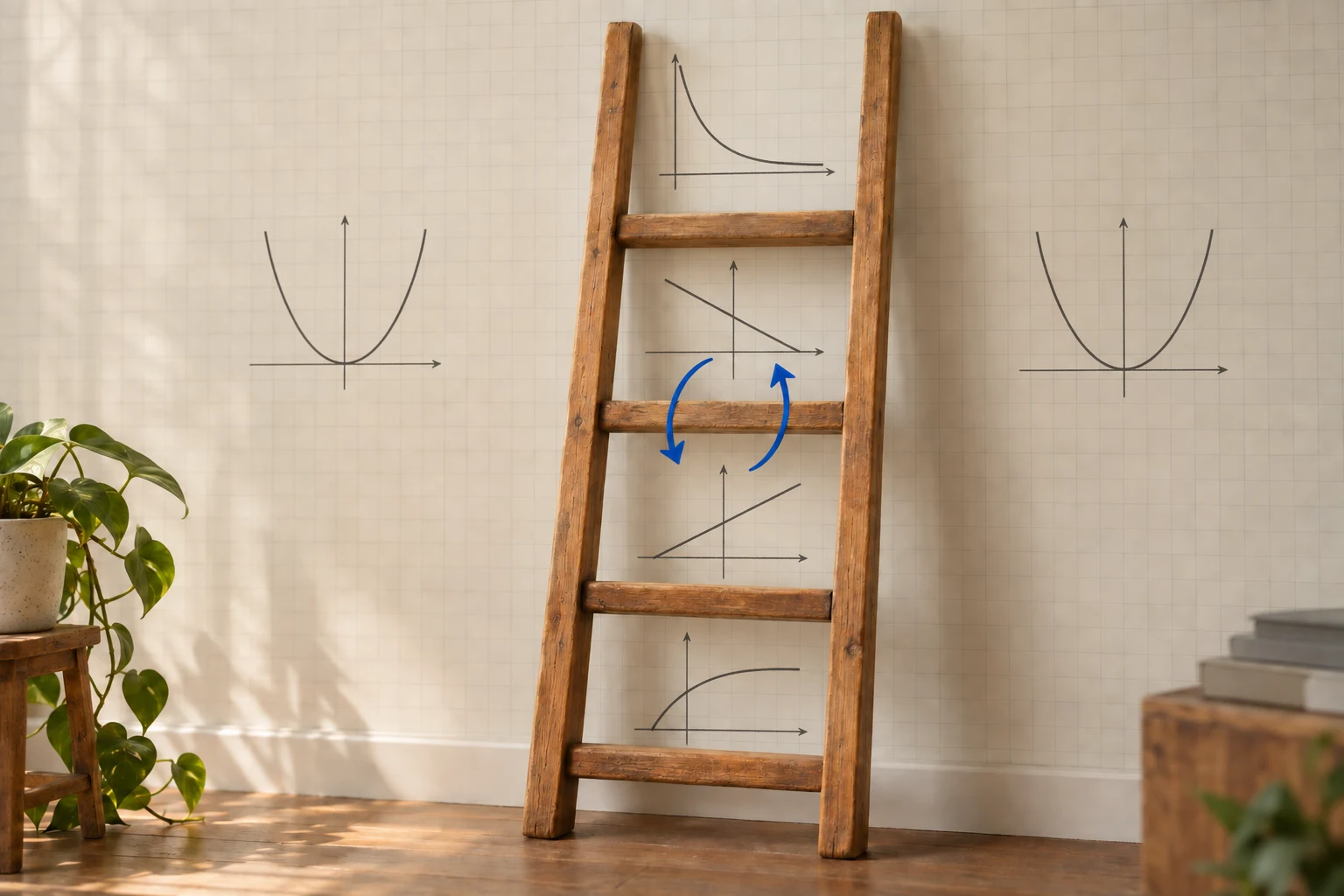
Picture a ladder. Write multiples of two on the rungs and climbing means adding two while descending means subtracting two, which is what inverse operations look like. Write powers of two instead and up becomes multiply, down becomes divide. Same ladder, same relationship.
Now write functions on the rungs. Going down is differentiating. Going up is integrating. Each function, in the walkthrough's phrasing, "is the derivative of the one above, and the integral of the one below." That's the fundamental theorem in one picture, and it's why the second part of the theorem is a computation rule you can use: the definite integral from a to b equals the antiderivative evaluated at b minus the antiderivative evaluated at a.
The Calculus Concept Explainer and Practice Generator explains any calculus idea at whatever depth you need and then hands you problems on it, which makes it the right first stop when a concept won't sit still.
Before You Start: The Algebra That Calculus Assumes
Most calculus failures are algebra failures wearing a calculus costume. Five prerequisites carry the load:
- Exponential functions run the growth-and-decay problems, and e shows up everywhere in derivatives, so the Exponential Function Practice Generator is worth a week before class starts.
- Logarithms are the inverse you'll need for logarithmic differentiation. Drill them with the Logarithm Practice Generator.
- Rational functions and their asymptotes preview limits at infinity, which is the same skill in different clothes, and the Rational Function Asymptote Practice Generator builds it early.
- Conic sections return in parametric and polar work later, covered by the Conic Sections Practice Generator.
- Complex numbers matter more than they look, since Euler's formula ties them to trig and calculus at once. Start with the Complex Number Arithmetic Practice Generator.
Weak on the algebra underneath all five? Repair that first with our exponent rules guide, because every derivative you take will use those laws.
Limits: The Idea Everything Else Rests On
A limit asks what a function approaches, not what it equals, and that distinction is the entire reason calculus can talk about an instant rather than an interval. Get it wrong and derivatives never make sense, because the derivative is defined as a limit. The Limits Practice Generator works the standard cases, including the ones that look like they divide by zero until you factor.
Derivatives: The Rules Are Fewer Than They Look
Every derivative problem in first semester is a small set of rules applied in combination. Power, product, quotient, chain. The chain rule causes the most damage, because spotting the inner function is a judgment call that no formula makes for you. Trig derivatives add one more dependency: sine and cosine differentiate into each other, and the exact values you plug in come straight off the unit circle.
The Derivative Practice Generator produces problems by rule, so you can spend an evening on chain-rule cases alone instead of a shuffled mix that lets you avoid the one you dread. Implicit differentiation, where y is tangled with x and you differentiate anyway, is the technique that unlocks the applications below.
The Bridge: Antiderivatives and the Reversed Power Rule
An antiderivative is defined by inversion. Capital F is the antiderivative of little f when F prime equals f, which the walkthrough compares to squaring a square root and landing back inside.
That inversion tells you the rule without memorizing a second one. Differentiating brings the exponent down and reduces it by one, so antidifferentiating raises the exponent by one and divides by the new exponent. The antiderivative of x squared is x cubed over three, and you verify it by differentiating: the three comes down, cancels the three underneath, and leaves x squared.
Run that through the theorem with real limits. The integral of x squared from 0 to 1 equals one third minus zero, so one third. The rectangles-under-a-curve method gives the same number, which is the proof-by-agreement that makes the theorem land. As the walkthrough puts it, integral calculus and differential calculus are "united at last," and nobody has to draw rectangles again.
Notation earns a minute here too. That elongated integral sign is Leibniz's, shaped like a long S because it stands for a limit of sums, and the dx at the end "has no meaning by itself" while being required for the notation to work.
Integrals and the Questions They Answer
Integration practice splits between technique and application, and the Integral Practice Generator covers both, from u-substitution through the definite integrals that produce a number instead of a family of functions.
| Application | The question it answers | The tool |
|---|---|---|
| Related rates | How fast is one quantity changing when another changes? | Related Rates Practice Generator |
| Arc length | How long is a curved path? | Arc Length Formula Solver |
| Differential equations | What function satisfies this rate relationship? | Differential Equations Intro Practice Generator |
Related rates deserve the extra warning. The calculus is easy and the setup is where students lose points, because you have to name the variables, find the equation connecting them, and differentiate with respect to time before touching a number. Motion is the friendliest case: position, velocity and acceleration sit on one ladder, which is what the kinematic equations in physics quietly assume.
Sequences and Series: The Last Unit Nobody Warns You About
Calculus 2 ends somewhere unexpected, in infinite sums that converge or don't. The pattern-recognition it demands starts earlier and simpler with the Sequence Pattern Identification Practice Generator, which trains you to see the rule behind a list of numbers.
The famous payoff is Euler's formula, where an infinite series ties e, i, and the trig functions into one identity that most people meet as a tattoo before they meet it as mathematics. The Euler's Formula Explainer works through why it's true rather than only quoting it.
| Option | What you get | Best for | Skip if |
|---|---|---|---|
| A derivative or integral calculator | The answer and sometimes the steps | Checking work you already did | Reading someone's steps isn't producing them, and exams want production |
| Textbook odd-numbered problems | Answers in the back, curated difficulty | Assigned homework | You've run out, and you need fresh calculus practice problems on one weak technique |
| The generators above | Unlimited problems targeted to a single rule or concept | Drilling the technique that's costing you points | You haven't seen the concept yet, read or watch first |
Keep one Dock Editor document as a running rules sheet: each rule, one worked example, and the mistake you made the first time. Rebuilding that sheet from memory the week before a final is the most efficient review in the subject, and the first week costs nothing. Sitting AP Calculus? Our AP practice tests by subject guide covers the timed-exam side.
Test the ladder yourself tonight. Take any function, differentiate it, then antidifferentiate the result and see whether you land where you started. When you don't, the gap you find is the thing to practice tomorrow. Every math generator sits with the rest in the education prompt library.