Sixteen angles, sixteen coordinate pairs, all of it gone two weeks after the test. That's the standard unit circle experience, and a trig teacher who used to drill it into his own students calls memorizing the whole thing "a big waste of time" in a lesson arguing against it. His case is structural: the chart is the first quadrant reproduced four times, flipped left to make x negative and down to make y negative. Learn one quadrant and two ideas, and the other three quadrants come free.
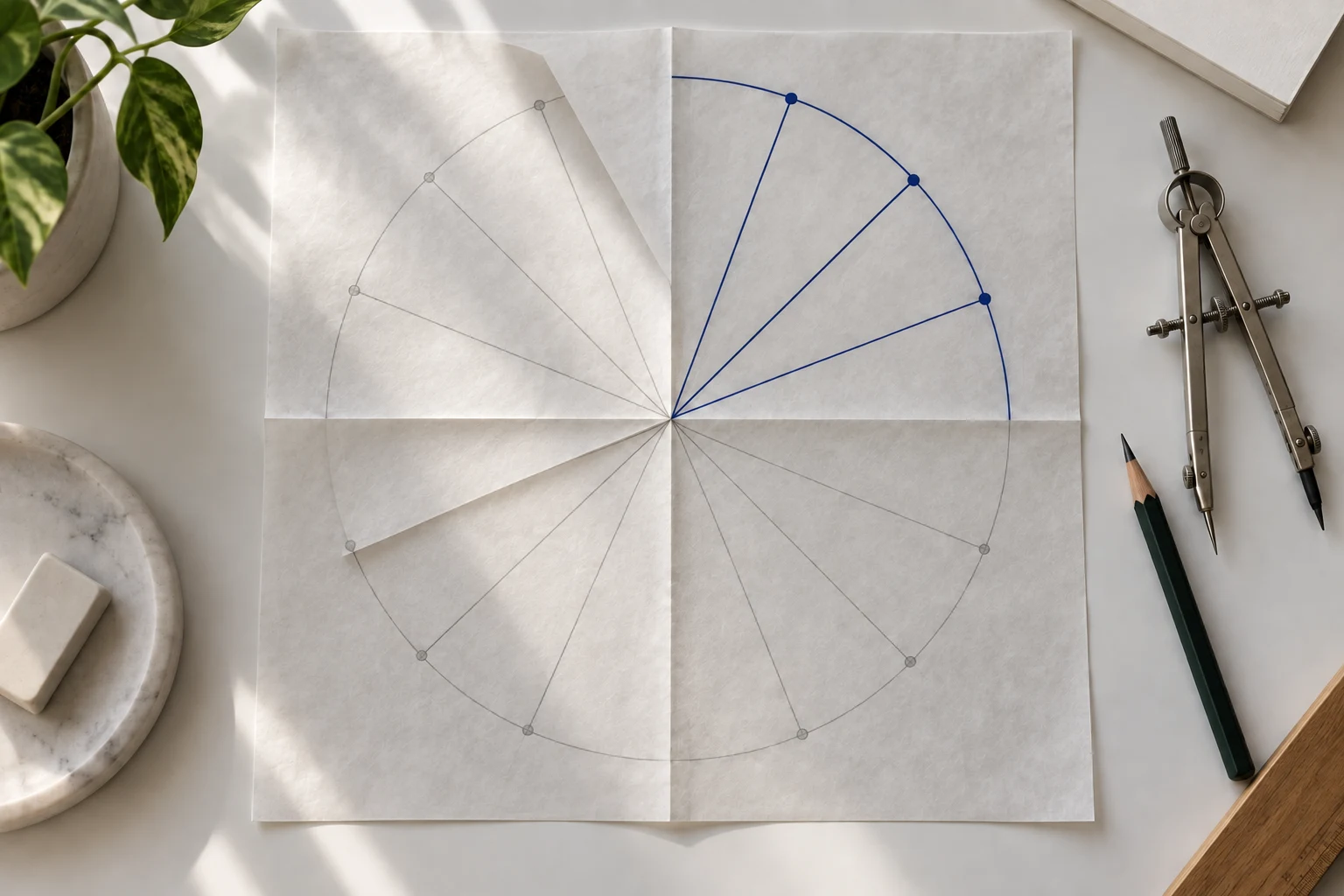
This guide teaches that method, then runs the rest of trigonometry from right triangles to identities, with a generator for the practice each piece needs.
What the Circle Is, Before Any Memorizing
A unit circle is the circle of radius 1 centered at the origin, so every point on it satisfies x squared plus y squared equals 1. The payoff is the naming: for an angle measured from the positive x-axis, the x-coordinate is the cosine and the y-coordinate is the sine. Tangent is y over x, which is why tangent goes undefined wherever x hits zero.
That equation is worth practicing on its own, since circle problems in coordinate geometry are the same object shifted and scaled. For the general form, work problems with the Equation of a Circle Solver. The special case, with the angles your test will use, belongs to the Unit Circle Practice Generator.
Two Ideas That Replace the Memorizing
The method needs the first quadrant plus two definitions.
A reference angle is the acute positive angle between your angle's terminal side and the x-axis. A coterminal angle starts and ends on the same sides as your angle but differs by a full revolution, so coterminal angles differ by plus or minus 2 pi. Together they reduce any angle you're handed to one you already know.
Here's the procedure with the lesson's own examples:
| Problem | Reduce it | First-quadrant value | Fix the sign | Answer |
|---|---|---|---|---|
| sin(2π/3) | Reference angle π/3 | (1/2, √3/2) | Quadrant II: x negative, y positive. Sine is y | √3/2 |
| cos(−5π/4) | Reference angle π/4 | √2/2 | Quadrant II: cosine is x, so negative | −√2/2 |
| tan(15π/6) | Subtract 2π (12π/6), leaving π/2 | (0, 1) | No reference angle needed | 1/0, undefined |
The second and third rows are the point of the whole approach. A memorized circle covers positive angles from a standard-position chart, so a negative angle or anything past 2 pi sends memorizers hunting while you reduce and read. Drill the reduction until it's automatic, and the chart becomes something you can rebuild rather than recall.
SOHCAHTOA: Where the Ratios Come From
Before the circle, trig is triangles. Sine is opposite over hypotenuse, cosine is adjacent over hypotenuse, tangent is opposite over adjacent, which the mnemonic SOHCAHTOA packs into one nonsense word that generations have muttered during exams. Our mnemonic devices guide shows how to build a hook like it for any list. The Right Triangle Trig Solver works those problems with steps shown, including the inverse-trig direction where you know two sides and need the angle back.
Two triangles deserve separate attention because their exact values populate the first quadrant you're learning: the 30-60-90 and the 45-45-90. Those are covered in depth in our special right triangles guide, and the relationship underneath both of them belongs to the Pythagorean Theorem Solver.
Radians: The Unit That Makes Everything Later Work
Degrees are arbitrary, 360 of them because of an old calendar. Radians measure angle by arc length on a unit circle, so a full turn is 2 pi and the mathematics downstream stops needing conversion factors. Run degrees-to-radians through the Unit Conversion Practice Generator until the common values stop needing thought.
Radian measure pays off immediately in arc length, where s equals r times theta only if theta is in radians, and the Arc Length Formula Solver works those problems for any circle.
Identities: The Part That Looks Like Memorizing and Isn't
Trig identities are where students reach for flashcards and shouldn't. The Pythagorean identity, sine squared plus cosine squared equals one, is the circle equation with the coordinates renamed. Once you see that, it's derivable rather than memorable, and its two cousins come from dividing it through by sine squared or cosine squared.
Verifying identities is the actual skill, and it's a puzzle skill: transform one side until it matches the other, never both at once. The Trig Identities Practice Generator produces fresh verification problems, which beats rereading a worked solution you've already seen.
Triangles That Aren't Right Triangles
SOHCAHTOA needs a right angle. Real problems often don't have one, and two laws cover the gap.
- The Law of Sines Solver handles the angle-side-angle and side-side-angle cases, including the ambiguous case where two different triangles satisfy the same measurements.
- The Law of Cosines Solver takes over for side-angle-side and side-side-side, and it's the Pythagorean theorem with a correction term for the angle not being 90 degrees.
- Area gets a trig upgrade too. One-half times two sides times the sine of the included angle works when no height is given, a formula the Triangle Area Solver applies alongside the base-height version.
Where Trigonometry Goes Next
Two destinations make the effort worthwhile. Complex numbers get a polar form built entirely from cosine and sine, which turns multiplication into angle addition, and the Complex Number Arithmetic Practice Generator builds that fluency. The Euler's Formula Explainer then shows why e raised to i theta equals cosine theta plus i sine theta, the identity that ties trig to exponentials.
The other destination is calculus, where the derivatives of sine and cosine cycle through each other and every wave problem starts here. That course has its own guide at fundamental theorem of calculus.
| Option | What you get | Best for | Skip if |
|---|---|---|---|
| A printable unit circle chart | All 16 points, ready to tape inside a binder | Checking a value fast during homework | Charts get confiscated on test day, and reading isn't recall |
| A trig calculator | Decimal answers instantly | Applied problems where the exact form doesn't matter | Your test wants √3/2, not 0.866 |
| The generators above | Fresh problems on the exact skill you name | Building the reduce-and-read habit until it's automatic | You haven't learned reference angles yet, start with the table above |
Keep a rebuilt circle in a Dock Editor document, drawn from memory each week with the values you missed marked in a different color. Three weeks of that and the chart stops mattering, which is the goal. The first week of the editor is free.
Try the test tonight: draw the first quadrant from scratch, then have someone hand you a negative angle bigger than 2 pi. If reduce-then-read gets you there faster than a memorized chart would, you're done with flashcards. Every math generator lives in the education prompt library.