Ask Google how many kinematic equations there are and the follow-up questions can't agree: four formulas, the big five, the big four. The honest count is four core equations, a fifth if your textbook splits one variant out, and one rule that matters more than the number: they only work when acceleration is constant and not zero.
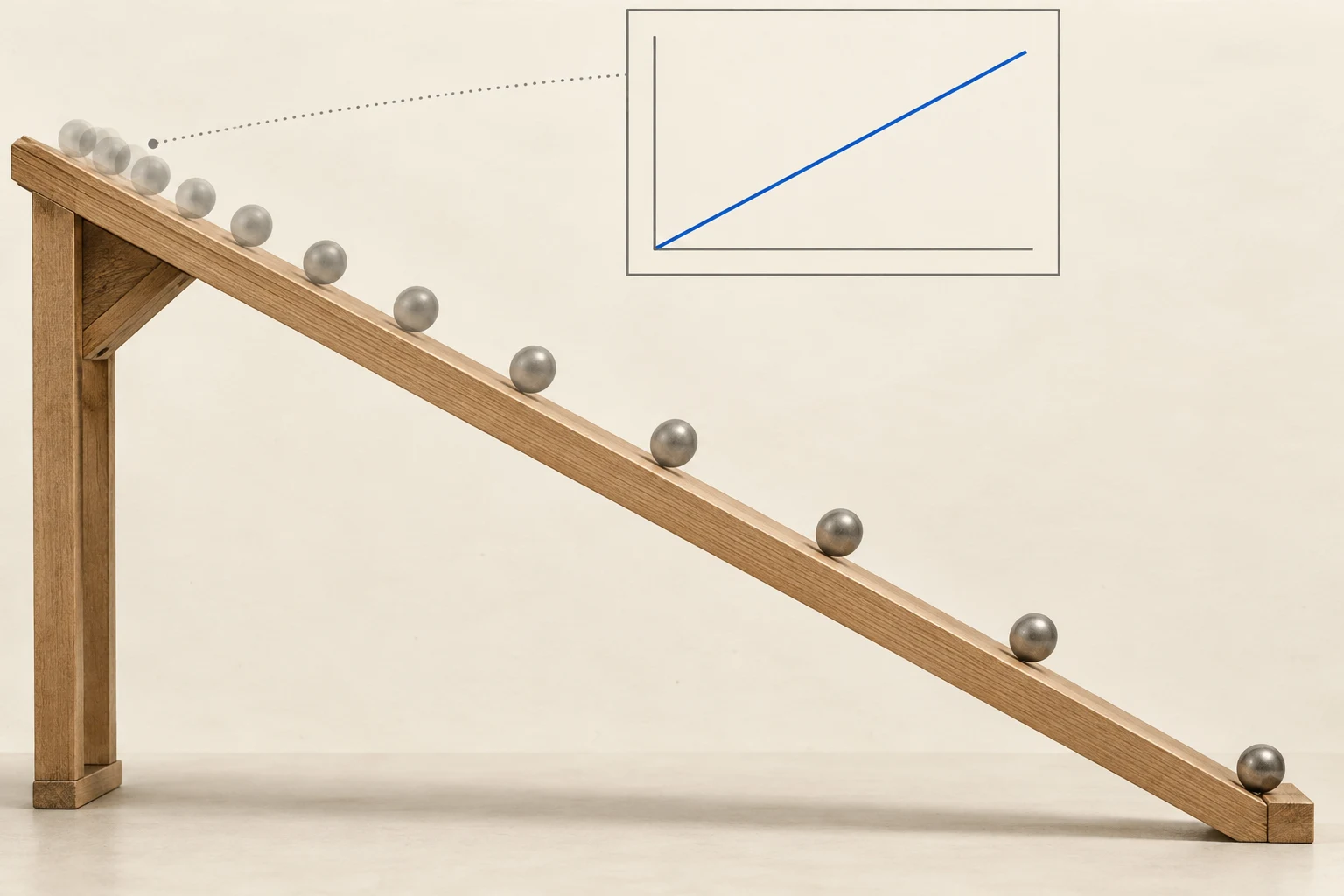
That rule is the part graded exams test. Plug a kinematic equation into a changing-acceleration problem and every step after is confidently wrong. So here are the four, the condition, the three-of-five method for choosing between them, and the solver prompts for the mechanics units that follow.
Four Equations Share One Condition
In the notation your class probably uses (v₀ is the same as "v initial"):
- v = v₀ + at
- Δx = v₀t + ½at²
- v² = v₀² + 2aΔx
- Δx = ½(v₀ + v)t
Equation 3 is the one students nickname the no-time equation, since t never appears in it. Equation 4 is the odd one out for a different reason: the rank-one tutorial for this exact topic puts it bluntly, "if you didn't learn it, it's because your teacher didn't tell you."
The condition comes before all four. They hold only when acceleration is constant and non-zero. When acceleration changes, velocity and position come from derivatives and integrals instead, the subject of our fundamental theorem of calculus guide. Zero acceleration means constant velocity, and constant velocity is plain d = vt, no kinematics required. And Δx means displacement, the change in position, because as the tutorial's example runs, a runner who starts at the six-meter mark and covers three meters ends at nine, not three.
Three of Five Variables Decide Everything
Every kinematics problem hands you the same five variables: v₀, v, a, t, Δx. The working method is mechanical. List all five, fill in what the problem states, and find the ones it hid in plain English: "starts from rest" sets v₀ to zero, "comes to a stop" sets v to zero, "dropped" hands you gravity for a. Three known variables unlock the problem, and which equation you pick is decided by which two of the remaining variables you care about.
The Kinematics Equations Solver runs exactly that method on your problem: it extracts the five variables from the wording, names the hidden ones, picks the equation and shows the algebra. Use it to check your setup, because setup is where kinematics problems die.
| Tool | What it does | Best for | Skip if |
|---|---|---|---|
| A formula sheet | Lists the equations | The night-before refresher | You can't tell which equation fits which problem, which is the graded skill |
| A solver prompt | Works YOUR problem step by step, variables first | Checking setup and finding the hidden variable | You haven't attempted it once yourself |
| A practice generator | Builds fresh problems on one concept | Drilling the unit before the exam | You're still missing the concept, not the reps |
Forces Arrive Next, and Diagrams Decide Them
The second mechanics unit swaps equations for forces, and the skill shifts to drawing before computing. The three laws, both kinds of friction and the inclined plane are worked through in our friction and Newton's laws guide.
- The Free Body Diagram Practice Generator drills the diagram itself, which is where force problems are won.
- Forces are vectors, and the Vector Addition Practice Generator covers the component work that feeds every diagram.
- The Coefficient of Friction Formula Solver takes the μ problems, the Newton's Third Law Practice Generator untangles action-reaction pairs, and inverse-square gravity questions go to the Newton's Law of Gravitation Solver.
Energy Problems Reward the Shortcut
The work-energy theorem says net work equals the change in kinetic energy, which quietly deletes time from problems that would take three kinematic steps.
- The Work-Energy Theorem Solver applies the shortcut and shows when it's legal.
- The component formulas each get a dedicated solver: Work and Power for the W = Fd and P = W/t family, Kinetic Energy for ½mv².
- Springs store the other kind of energy, and the Hooke's Law Spring Constant Solver works the F = kx family.
Momentum Owns Every Collision Question
Momentum is p = mv, conservation says the total before equals the total after, and that one line solves every collision on the exam.
The Momentum Solver handles the direct calculations, and the Elastic and Inelastic Collision Solver works the two collision types, including the distinction the test always probes: kinetic energy survives elastic collisions and bleeds away in inelastic ones, but momentum is conserved in both.
Rotation Retells the Whole Course in New Symbols
Rotational motion is mechanics with the nouns swapped: displacement becomes angle, velocity becomes angular velocity ω, force becomes torque, and every kinematic equation has a rotational twin. Students who see the mapping learn the unit in a week. Students who treat it as new material drown. Mass has a rotational twin too, and moment of inertia is the one students confuse most.
- The Torque Formula Solver covers τ = rF sin θ, and the Torque and Angular Acceleration Solver runs the rotational version of F = ma.
- Circular motion sits between the units, and the Centripetal Force Solver handles the v²/r family.
- Oscillation closes the course, and the Simple Harmonic Motion Solver covers springs and pendulums, with the Mechanical Advantage of Simple Machines Solver picking up the levers-and-pulleys problems that show up in applied courses. Oscillation is also the doorway to waves, where the second semester starts, covered in our Doppler effect to half-life guide.
Memorize by Volume, Not by Staring
The tutorial's memorization advice matches how physics teachers grade: do enough practice problems that the four equations stick without feeling memorized. For the symbol-heavy leftovers, the Flashcard Generator turns your formula sheet into a reviewable deck.
Keep the variable lists and worked problems in one place. The Dock Editor holds your five-variable setups next to the solver output, and a 7-day free trial covers an exam cycle.
Take the problem set due this week and run the first problem yourself, five variables listed, before touching a solver. Then check your setup against the Kinematics Equations Solver's. Where they differ is the exact line your exam would have taken points from. Browse the physics prompt library for the thirty-plus other solvers.