The most useful essay lesson we've found tells you to hold your best ideas back. Professor Tim Wilson's walkthrough runs against every intro-body-conclusion diagram you've seen: don't spread your material evenly. Save it.
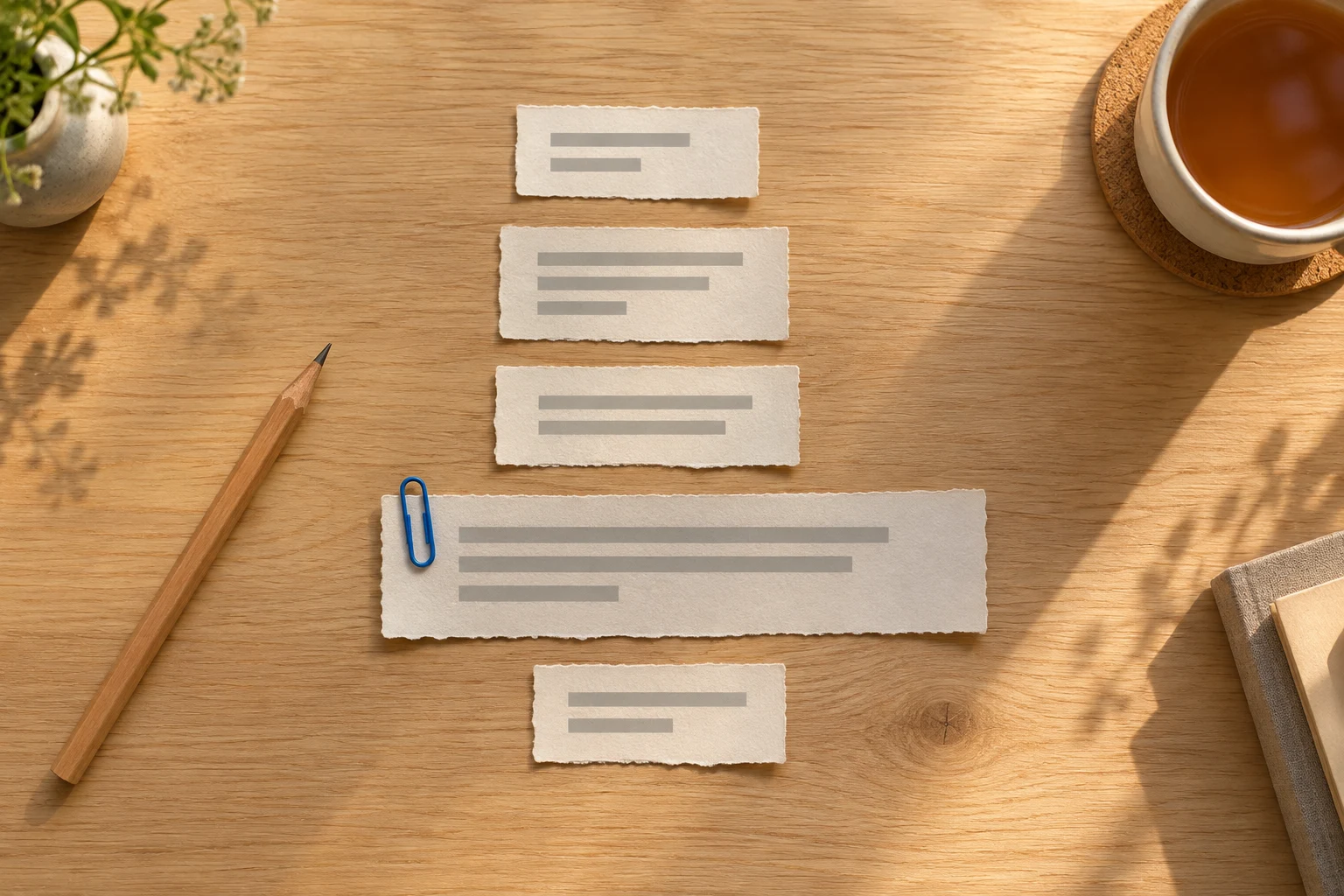
His planning advice runs the same direction: "There is only one way to write an essay, and that is to plan it," but "the plan is about what you don't say." You get your best ideas on paper first so you can keep them out of your opening paragraphs on purpose.
Here's the whole structure, part by part, with a prompt for each part that generates practice on your own topic.
An Essay Is Five Parts, and They Aren't Equal
| Part | Job | Length | Best for | Skip if |
|---|---|---|---|---|
| 1. Introduction | Say how you'll answer the question | Brief | Every essay. It's the contract | You're tempted to summarize everything here. Don't |
| 2. First body | Present the case, one side | Medium | Showing you know the material | Nothing. It always runs |
| 3. Second body | Present the balance, other side | Medium | Fairness the reader can see | The prompt really has one side |
| 4. The crunch | Refute, then land your best point | Longest | The paragraph that earns the grade | Nothing. This is the essay |
| 5. Conclusion | Close what you opened | Brief | Following naturally from part 4 | You're about to add a new idea. That's a new essay |
Wilson's word for part 4 is "the crunch," and his description of it is the article's best sentence: after presenting both sides politely, "one, two, three reasons why your position is wrong, and bang."
- Before any of it, run your topic through the Thesis Statement Generator so the five parts have one claim to serve. Our thesis examples guide shows what a strong one looks like per essay type.
- The Research Paper Outline Generator builds the skeleton with your points distributed the Wilson way rather than evenly.
Plan by Deciding What to Leave Out
Most students treat a plan as a miniature essay. Wilson has watched that fail from the marking side: "I've seen some plans where people have written so much they might just as well have written the essay."
The plan's real job is triage. Everything you know goes on paper, then you choose what the opening paragraphs won't get. Your two or three strongest points are reserved for the crunch, and the merely solid material fills parts 2 and 3.
- Dump every point you have into the Outline Method Notes Converter and it organizes the pile into a hierarchy you can carve up.
- Arguing a side? Generate the opposition first with the Counterargument Generator. Part 3 needs it, and the crunch needs something to refute.
The Introduction Is a Contract, Not a Trailer
Part 1 has one job: "establish how you intend to answer the question." It's brief on purpose. Every good idea you put here is one the crunch can't land later.
- The Introduction Generator drafts openings that commit to an approach without spending your material.
- The first sentence is its own problem, and it's covered in how to start an essay, with the Hook Generator for options when nothing lands.
Body Paragraphs Run on One Pattern
Parts 2 and 3 demonstrate that you know the material, and each paragraph inside them runs the same cycle: claim, evidence, reasoning. That cycle has its own worked guide, and the pieces each have a prompt:
- The Topic Sentence Generator writes the claim line that opens a paragraph: a mini-thesis, not a fact.
- The Paragraph Structure Explainer checks a drafted paragraph against the cycle and names what's missing.
- Evidence needs handling rules of its own, see textual evidence for finding and citing it.
- Between paragraphs, transitions signal the logical relationship, not decoration. The Transition Words Helper sorts them by job, and the full sorted list lives in transition words for essays.
Quote in Threes or Don't Quote
Wilson's rule for evidence is mechanical enough to check on every draft: "A quotation by definition requires three sentences. A sentence to establish the quotation, to quote, and then to explain the quotation."
His image for the third sentence: a quotation is a jewel in a ring. You take it out, and in your essay "you're only interested in one or two facets."
The explaining sentence says which facet. Skip it and the quote is decoration.
And the length discipline, from a man who has marked thousands: "I have seen essays where the quotation is twice the length of the original work written by the student. This is absurd." Brief quote, three sentences of setting.
- Restating a source in your own words is the other evidence move, and it has its own trap, how to paraphrase without plagiarizing covers it.
- If the essay argues, the Argumentative Essay Writer, the most-used writing prompt in the library, shows a finished argument to compare against, and counterclaims covers the refutation half.
The Conclusion Closes. It Doesn't Open.
Wilson's line covers the whole section: "If you want to start a new idea, you might as well write a new essay." Part 5 follows naturally from the crunch, restates nothing at length, and introduces nothing.
- The Essay Conclusion Writer drafts closings that extend part 4 instead of summarizing parts 1 through 3. The conclusion guide explains why the summary version fails.
The Structure Flexes by Essay Type
The five parts hold. What fills them changes. Match the prompt to the assignment, and use the types of essays breakdown if you're unsure which one you have:
- Narrative Essay Writer: the story replaces the for/against balance, but the crunch survives as the turning point.
- Informative Essay Writer: parts 2 and 3 become aspects of the topic rather than sides.
- Cause and Effect Essay Writer: causes in part 2, effects in part 3, the strongest causal link in the crunch.
- Critical Essay Writer: closest to Wilson's exam model, refutation and all.
- Personal Essay Writer and the Scholarship Essay Writer: the five parts compress, but the hold-your-best-for-late rule matters even more at 650 words.
Revise Structure First, Sentences Second
A clean sentence in the wrong paragraph is still wrong. Check the shape before the grammar: does the intro promise what the essay delivers, does the crunch carry your best material, does the conclusion add anything it shouldn't.
Then the sentence pass:
- The Grammar Checker catches the mechanical marks, and the commonly confused words list covers the wrong words it can't see.
- Two complete sentences joined by a comma is the most common error in student drafts, and the Run-on Sentence Fixer trains you to spot it.
Keeping the plan, the draft, and your source quotes in one document is what makes the save-it-for-the-crunch method workable, because you can see what you're holding back. The Dock Editor is free for 7 days and runs any of these prompts against the document already open.
Take whatever you're writing this week and try the unbalanced plan: list your points, pick the two best, and forbid them from appearing before part 4. If the essay reads flat before the crunch and lands hard at it, that's the structure working exactly as 6.2 million viewers were told it would. Browse every writing prompt for the rest of the academic set.